Feedlots – Real Minds AI
Industry · Feedlots

AI for cattle feedlots, grounded in your own pen, ration, treatment, and compliance records.

Get your best pen riders and office staff out of the paperwork and back to the cattle — drawn from your own records, a person signs off.
In one line

AI for Australian cattle feedlots and lot feeders is grounded, auditable software that RMAI builds on your own pen, ration, treatment, and compliance records — so NFAS audit evidence, pen closeouts and cost of gain, MSA grid feedback, off-feed differentials, NLIS withholding and export-slaughter-interval ship holds, and feed-shrinkage reconciliation are drafted, checked, and cited to their source in minutes, with the manager, nutritionist or consulting vet reviewing and signing off every result. Grounded on your own yard data, never a public chatbot guessing at a residue date.

Last updated 16 June 2026·TA reviewed by Tracy Anthony, principal · RMAI
01The situation

What actually drains a mid-sized Australian feedlot now.

It isn’t the stockmanship — it’s everything around it. BRD is the biggest health cost and sick cattle hide it until it’s expensive; pulls and deaths leak roughly $22,000 for every 1,000 head turned off, much of it preventable with earlier detection; the annual NFAS audit is a document-heavy scramble because the evidence lives across paper, email and five systems that don’t talk; and the labour market caps the yard below its licence because the people simply can’t be hired. Feeder-cattle purchase is the dominant cost in the Australian system (~70% of total) and feed the biggest variable cost once cattle are on feed (~20%) — but none of these problems is a cattle-judgement problem. Each is a records-and-reconciliation problem, the gap between your scale, your mill, your hospital pen and your office, which is exactly where grounded AI — constrained to your own records, cited, and reviewed — earns its place. (Cost-share figures indicative of the AU feedlot system.)

$40M+/yr, detected late

BRD is the biggest health cost, and sick cattle hide it until it's expensive

Bovine respiratory disease drives most feedlot sickness and death and is estimated to cost the Australian feedlot industry in excess of $40 million a year — and the best pen riders in the industry run about 65% accuracy diagnosing it by eye, because cattle instinctively mask illness and a rider has only seconds per animal across thousands of head. Animals that come through BRD return materially less at slaughter (one 898-steer Australian study put the penalty at $67.10 for a subclinical case to $213.90 for a clinical one). The detection is mechanical pattern-spotting across feed, behaviour and treatment data; the diagnosis and the treatment stay with the vet and the rider.

· MLA Final Report B.FLT.3004 (Prof. Darren Trott; BRD >$40M/yr); pen-rider ~65% accuracy — Andrew Talbot, GM Elders' Killara Feedlot (Beef Central 2021); per-animal penalty $67.10–$213.90 — Blakebrough-Hall et al. 2020 (898-steer AU study)
~$22k/1,000 head

Pulls and deaths leak roughly $22,000 for every 1,000 head turned off

An Australian survey put losses from pulls and deaths at more than $50 million a year across the industry — about $22,000 per 1,000 head turned off — and a large share is preventable with earlier detection rather than reactive treatment. On a yard turning off tens of thousands of head, that is a six-figure annual leak that tracks straight back to how late a problem is caught and how reliably it is recorded. The losses are real money; catching them earlier is a data-and-records problem before it is an animal-health one.

· MLA P.PSH.0547 — Australian feedlot survey, losses from pulls and deaths (>$50M/yr; ~$22,000 per 1,000 head turned off)
~400audited yearly

The NFAS audit is document-heavy, and the evidence is scattered until audit week

Close to 400 NFAS-accredited feedlots are independently audited every year against the National Feedlot Accreditation Scheme — five modules covering quality management, food safety, livestock, environmental and product integrity — and each yard must build and maintain a documented Quality Manual of policies, procedures and work instructions. In practice the SOPs, treatment logs, environmental readings and movement records live across paper, email and five systems that don't talk, so audit prep becomes a frantic week of assembly. The accreditation is non-negotiable for grain-fed market access; the scramble is just disorganised evidence.

· NFAS / AUS-MEAT — National Feedlot Accreditation Scheme (administered by AUS-MEAT, backed by ALFA; ~400 accredited feedlots, independently audited annually; five-module structure)
5,000of 10,000 licensed

The labour market caps your capacity before your licence does

One Queensland operator is licensed for 10,000 head but runs about 5,000 because, in the owner's words, 'they couldn't find the people to support the scale — I'd do it tomorrow if we had the staff.' Rural workforce scarcity is the binding constraint, and every skilled stockperson re-keying scale tickets, reading bunks by eye or hunting a treatment history in a binder is capacity not spent on cattle. The answer here is never fewer people — they are already hard to hire — it is getting the people you have out of the drudgery so the yard can run closer to what it's licensed for.

· Queensland Country Life — Melbrig Feedlot (licensed 10,000 head, running ~5,000 for lack of staff; owner quote)
02The value

What changes once the mechanical work runs on your own yard records.

Feedlots working with RMAI get their skilled crew’s hours back and tighten their compliance trail at the same time. The outcomes below are illustrative of patterns proven in Australian yards; each keeps a person on the final call — no animal pulled, treated, cleared for slaughter, or declared compliant on the tool’s say-so. The manager, nutritionist, consulting vet or stockperson reviews and signs. Put your own numbers into the estimator and benchmark further down to see what each of these is worth on your yard.

dayssooner
BRD found earlier off a data-generated pull list
The tool reads feed intake, behaviour and treatment data across the pens and drafts a ranked pull list — the animals that need a rider's eyes first, each flag tied to the signal that raised it. The rider still rides, diagnoses and treats; the vet still owns the protocol. What changes is that the rider goes to the right animals days sooner, before clinical disease and permanent lung damage set in.
minutesnot a week
NFAS and environmental audit evidence that assembles itself year-round
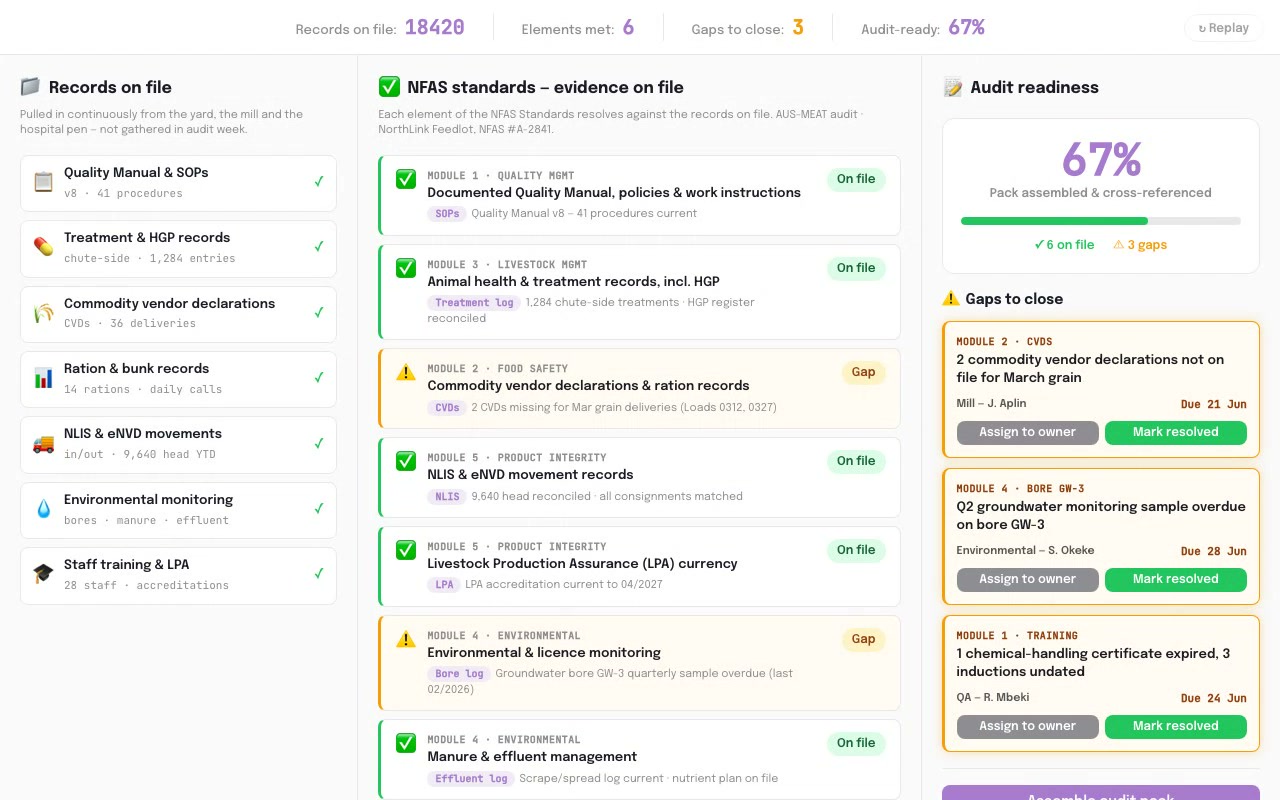
SOPs, treatment logs, effluent and groundwater readings, and movement records are indexed against the five NFAS modules as the year runs, so the Quality Manual stays current and a draft audit pack is one click away. The manager reviews each item against its source before the auditor arrives — audit week becomes a calm review, not a fire drill, and the person signing the declaration still owns it.
one numberone source
Closeouts and cost of gain that reconcile instead of disagreeing
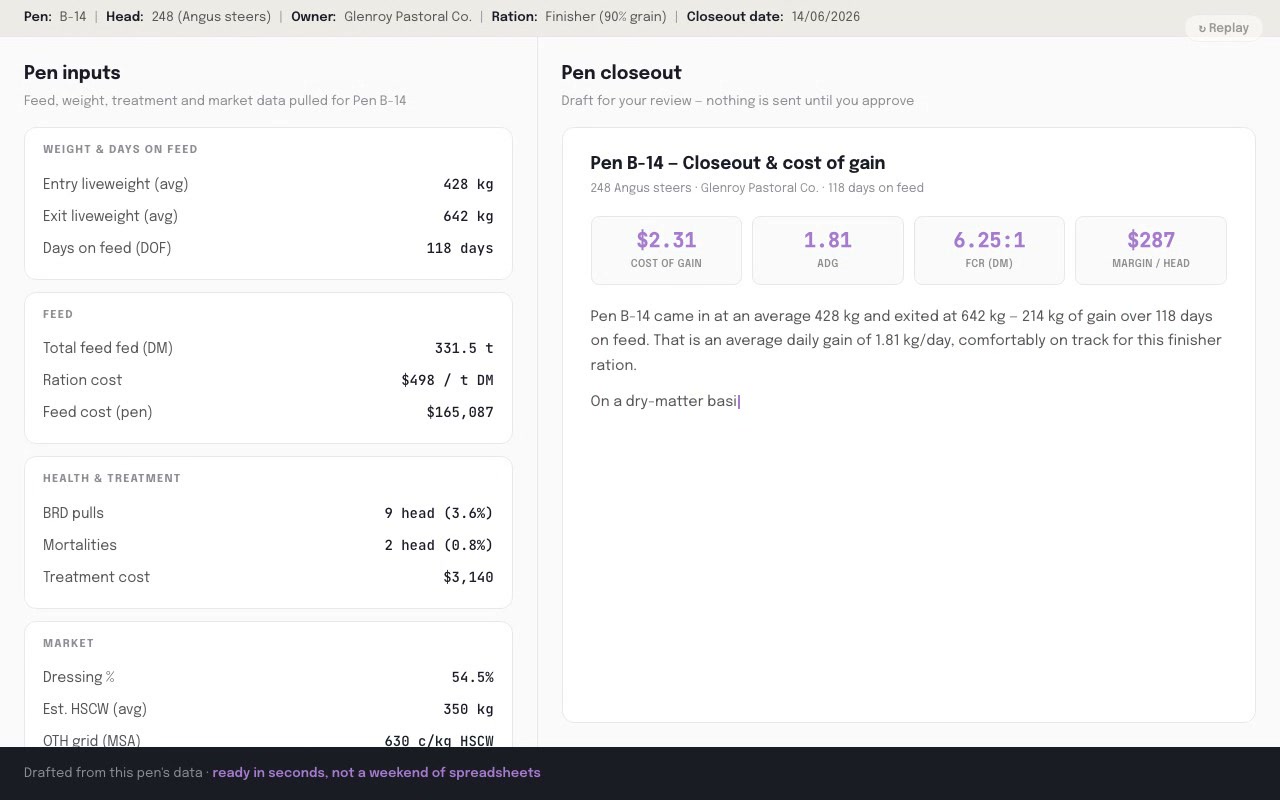
Feed, livestock, treatment and financial figures — today scattered across five spreadsheets that argue with each other — reconcile against one source, so a pen closeout with cost of gain, ADG and feed conversion on a dry-matter basis takes minutes and every figure links to its record. The nutritionist or manager checks the result and the plain-English explanation of what drove it, then signs; the tool never makes the call on its own.
03FAQs

The questions leaders ask first.

The questions below are the ones RMAI hears in the first call — on safety, staffing, compliance, cost, and feasibility.

Stay sceptical; that’s the right instinct. McKinsey’s 2025 global survey found 88% of organisations now use AI somewhere, but only about 6% are high performers attributing 5%+ EBIT impact to it — the hype is real, and so is the gap between a demo and a result. RMAI doesn’t sell ‘install AI and magic happens.’ We sell the unglamorous wins that are already proven in Australian yards: data integration, NFAS audit automation, and earlier BRD detection. The evidence is local and specific — MLA’s LiDAR-and-AI auto bunk-calling matched skilled human callers across 5,509 head with no negative health or performance impact (B.FLT.1012); MLA’s video weighing hit a 6.06% mean absolute error on 1,685 cattle with no handling (V.TEC.1731). We ground every tool on your own records and cite every output, so the question stops being ‘is AI magic?’ and becomes ‘how much of the paperwork can it take off my crew before the judgement starts?’
No — and in a feedlot that framing has it backwards. The binding constraint here is finding people, not having too many: operators run yards at half their licensed capacity for lack of staff. RMAI tools take the drudgery off your existing crew — re-keying scale tickets, reading bunks by eye, hunting treatment histories in binders, assembling the audit pack — so those hours go back into stockmanship and the growth the labour market otherwise blocks. The gain shows up as capacity recaptured, never headcount removed. We accelerate the thinking; we don’t replace the thinker, and on a workforce you can’t fully staff that’s the only gain that matters.
For detection and triage, with a human firmly in the loop, yes — and that’s exactly how RMAI builds it. The tool generates a ranked pull list from feed, behaviour and treatment data; your rider still diagnoses and your vet still treats. The bar to clear is the ~65% accuracy of skilled human pen-riding done with seconds per animal, and sensor and data-driven systems have matched or beaten that — but the tool’s job is to point the rider at the right pen sooner, not to make the call. For any decision where a wrong answer is catastrophic — a treatment, a residue date, a cull — the person stays in charge and signs. The tool flags; it never decides.
It treats them as the hard constraint they are. A withdrawal tracker reads each animal’s treatment record against the product’s withholding period (WHP) and export slaughter interval (ESI), and holds any animal whose longest binding interval hasn’t cleared — because the ESI can exceed the WHP, and the longest interval is the one that governs a ship date. It reconciles against NLIS movement and consignment data and surfaces a clear ship-hold list with the date and the product that set it. But the tool never clears an animal for slaughter on its own: it drafts the hold, cites the treatment record behind it, and a person confirms before anything moves. Manual day-counting by hand is where residue breaches come from; this is built to remove exactly that.
Both are real risks, and both are answerable in the contract before any build. Your yard data stays yours: you own it, you can export it — full stop. It’s built inside your own environment rather than routed through a public chatbot, and we make that a written requirement of any vendor in the stack. Your feedlot and livestock data stay inside your own tenancy and onshore in Australia, and are never used to train any third-party or public model. On lock-in — a feedlot’s software once nearly stranded a major yard on a single 80-something developer’s institutional knowledge until he retired, which is the exact dependency we design against. We prefer interoperable, exportable tools over closed ecosystems and we document everything, so you’re never hostage to one supplier or one staff member. Patchy rural connectivity is part of that design too: only about a third of Australian properties have whole-property mobile coverage, so we capture at the edge and sync when connected rather than assuming always-on.
That scar is common, and it’s why RMAI always starts with a fixed-price AI working session ($4,500, credited against the build) that tells you whether the pattern fits before any build — including the honest answer ‘not yet, your records aren’t ready’. A focused build typically ships in 3–6 weeks in the $10k–$60k AUD band: a narrow, measurable pilot run in parallel with your legacy process so nothing breaks during peak feeding or shipping — not a six-figure platform or a big-bang re-rip. You don’t backfill years of mess; you start clean with active pens and let the data spine build forward — and if the real bottleneck is institutional knowledge trapped in two people’s heads and SOPs that were never written down, writing that down is the first and most valuable job, bigger than the AI layer on top. Most of the work is already done; these are skins of patterns RMAI has shipped before, so a mid-sized yard pays for the bespoke ~30%. Given BRD alone costs the industry $40M+/yr and pulls-and-deaths run ~$22,000 per 1,000 head turned off, even modest detection and labour gains pay back inside a year — and we model ROI on labour and loss avoidance first, treating any feed-efficiency yield gain as upside, not a headline.
04ROI

What the time recovered is worth.

Move the sliders for your own volumes; the benchmark shows where shipped builds have landed.

Skilled-crew hours the paperwork eats — and what they're worth back on the cattle
Records, compliance & closeout tasks a month40
Minutes of skilled-staff time each takes today45
Loaded hourly cost of that staff time (A$)$65
$23,400 AUD / year
360 senior-staff hours returned each year. Directional — we firm this up in the diagnostic.
On these illustrative inputs the recovered time is worth roughly A$23k a year, so a typical A$10k–60k build pays for itself inside one to two years — then keeps paying. Directional only; we re-baseline to your own yard in the working session. · Net of the human review step — a manager, nutritionist or vet checks and signs every output.
Benchmark · per-task, shipped builds
before → after
TaskBeforeAfter
BRD pull list / earlier detection~65% accuracy by eyedata-ranked, rider confirms & treats
NFAS audit evidence assemblyfrantic week of paper chaseyear-round, draft pack in minutes
Pen closeout / cost of gainweekend pulling 5 spreadsheetsminutes, reconciled, manager signs
NLIS WHP / ESI ship holdcalendar days counted by handauto-checked, person clears
05Applications

What RMAI has built for this sector.

The applications below are grounded, human-in-the-loop tools for this sector — some already built and shipped, some scoped from real briefs. Ask us which is which.

Off-Feed Event Diagnostic

Off-Feed Event Diagnostic - Feedlots AI application
FeedlotsDecisioninginteractive demo

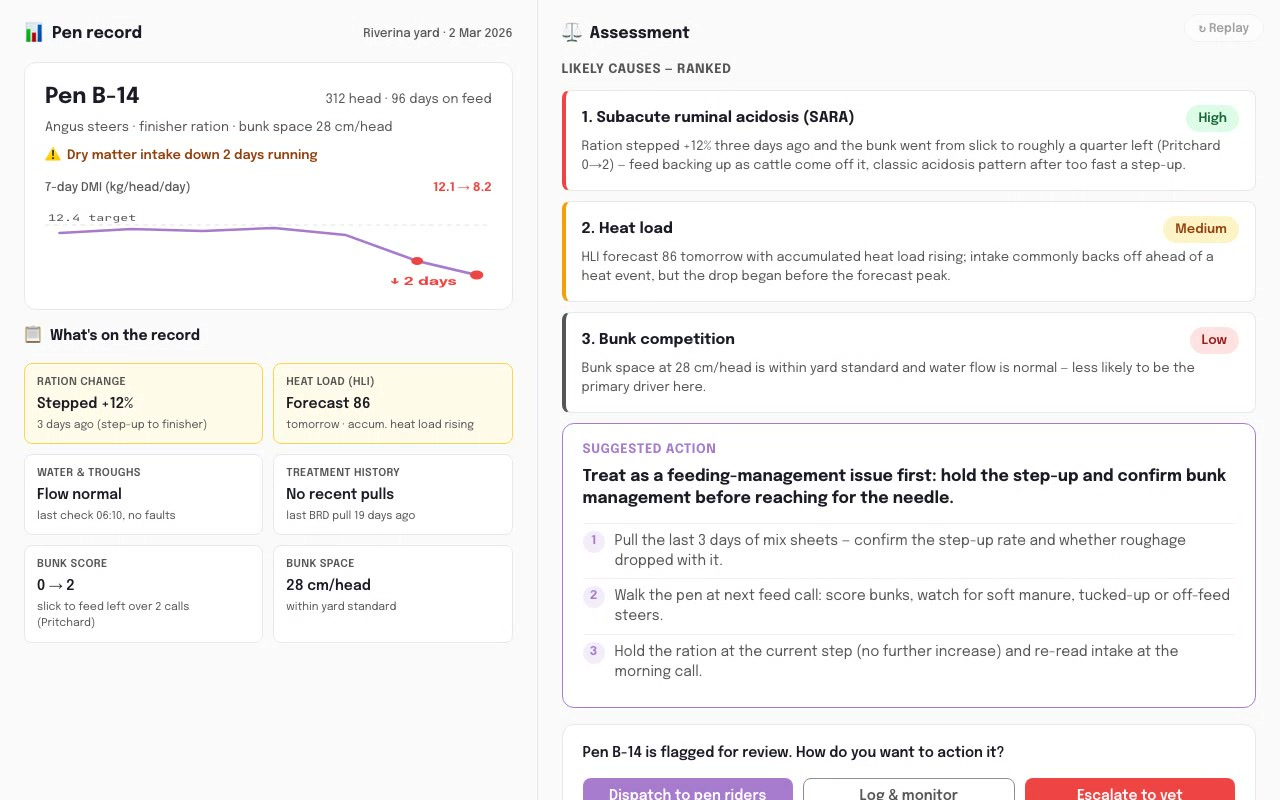
When a pen's feed intake drops two days running, it weighs the recent ration step-up, heat load, water and treatment history into a ranked list of likely causes — each with a confidence and a next step for the crew — so the manager or nutritionist decides and acts before the drop becomes acidosis or a missed BRD pull.

build est. · 3–4 weeks

Chute-Side Drug Withdrawal Tracker

Chute-Side Drug Withdrawal Tracker - Feedlots AI application
FeedlotsDecisioninginteractive demo

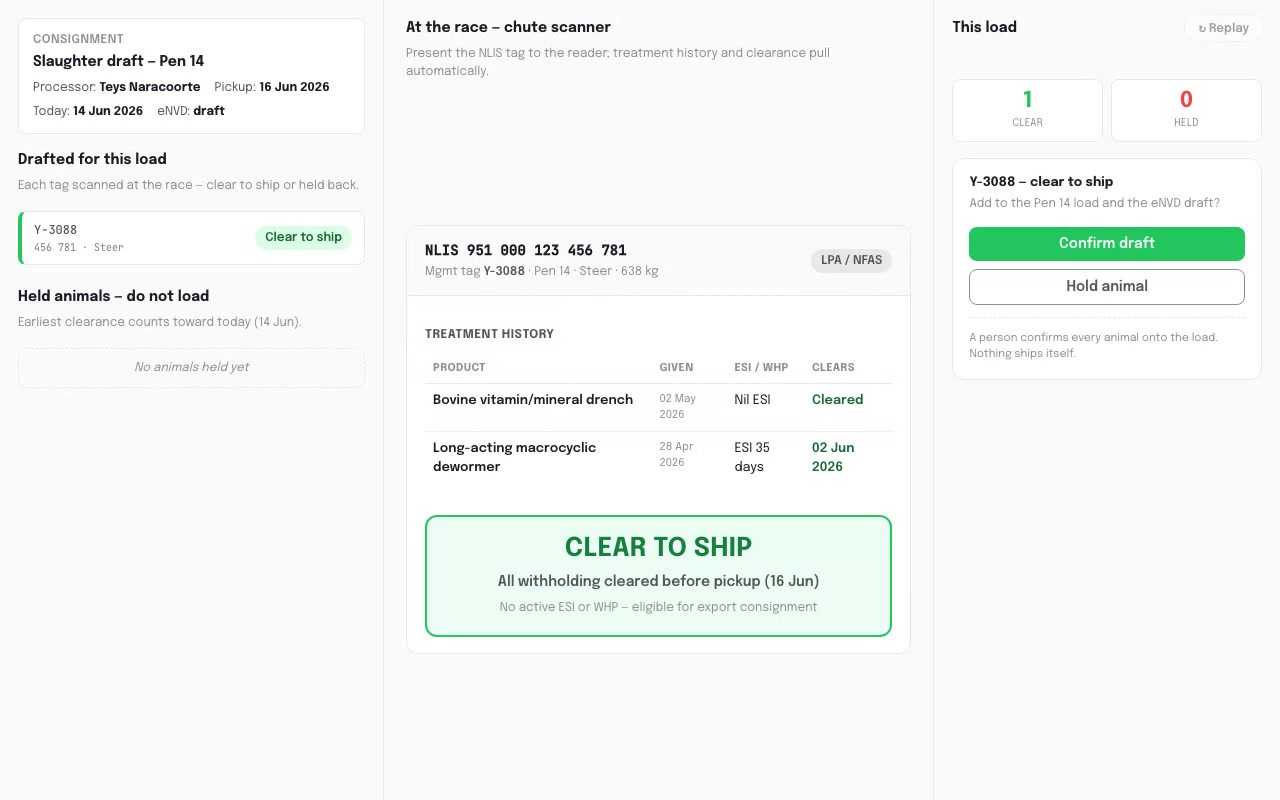
As each animal's NLIS tag is scanned at the chute, it pulls the treatment history, auto-calculates the binding ESI/WHP clearance, and shows an unmissable SHIP / DO NOT SHIP verdict with the clearing date and binding product — so no animal still under withholding is loaded for slaughter.

build est. · 4–6 weeks

Carcase Grid-Feedback Explainer

Carcase Grid-Feedback Explainer - Feedlots AI application
FeedlotsDecisioninginteractive demo

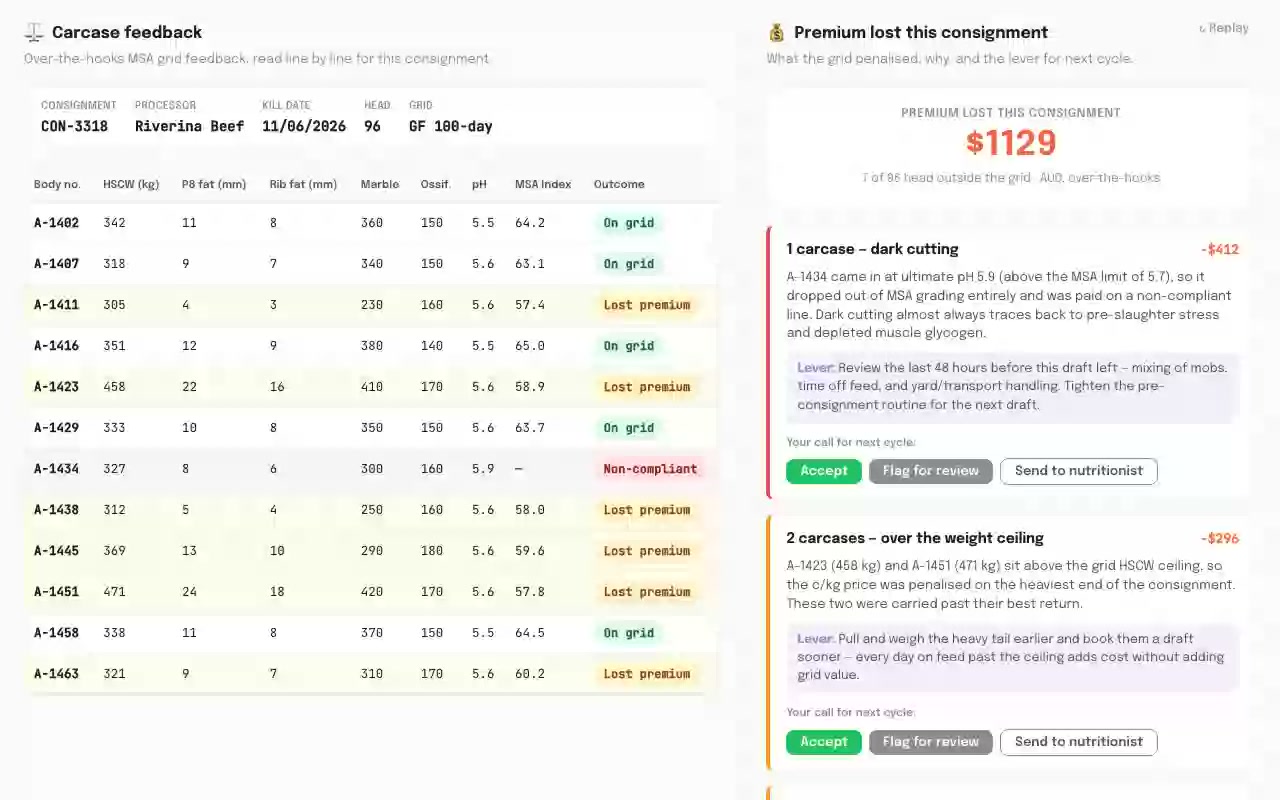
Reads the processor's MSA carcase grid-feedback sheet for a consignment and flags, carcase by carcase, where premium was lost and the likely cause — so the manager knows what to change next cycle.

build est. · 3–5 weeks

Feed Shrinkage & Silage Auditor

Feed Shrinkage & Silage Auditor - Feedlots AI application
FeedlotsDecisioninginteractive demo

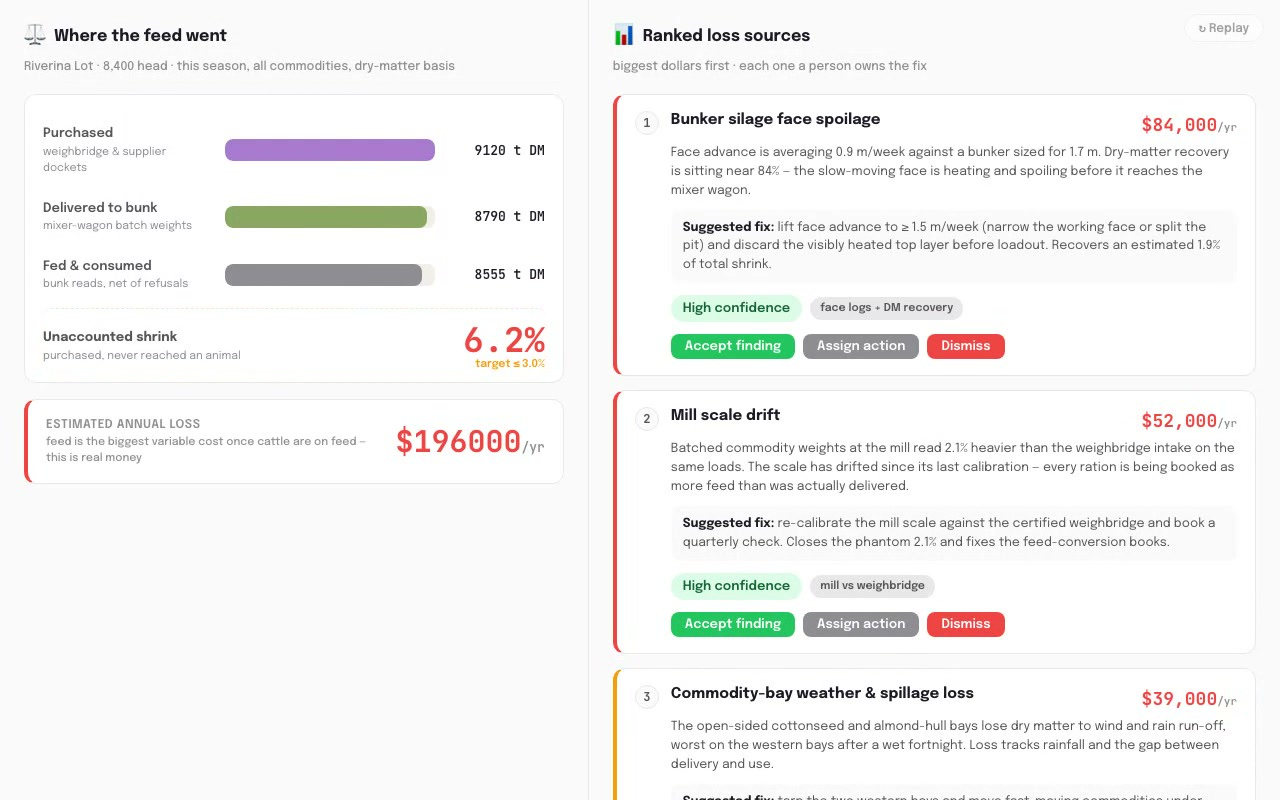
Reconciles commodity purchased against delivered-to-bunk against fed, finds the shrink gap, and ranks it into the dollar loss sources — mill scale drift, commodity-bay weather, silage face spoilage, over-mixing — each with a one-line fix for the manager or nutritionist to own.

build est. · 3–5 weeks

Closeout & Cost-of-Gain Summariser

Closeout & Cost-of-Gain Summariser - Feedlots AI application
FeedlotsDraftinginteractive demo

From a pen's feed, weight, treatment and market data it drafts a plain-English closeout — cost of gain, ADG, feed conversion, days on feed and margin — with an exit-timing recommendation, for the owner or business manager to approve before it goes out.

build est. · 3–4 weeks

NFAS Audit Evidence Hub

NFAS Audit Evidence Hub - Feedlots AI application
FeedlotsDocument processinginteractive demo

Continuously assembles your NFAS accreditation evidence — SOPs, treatment and HGP records, CVDs and ration records, NLIS movements, environmental monitoring — into a time-stamped, audit-ready pack and flags the gaps against the Modules and Elements before the annual audit arrives.

build est. · 3–5 weeks

06Prompts

Prompts you can use today, for free.

Sector-specific prompts RMAI uses as starting points. Copy one and run it against de-identified samples — or inside an approved private environment — to see the shape of the answer before you talk to us.

Closeout summary
Draft a plain-English closeout summary for this pen: cost of gain, average daily gain, feed conversion on a dry-matter basis, days on feed and margin, with one line on what drove the result. Cite every figure to its source record and flag any figure you had to estimate as low-confidence. Do NOT make a marketing or selling recommendation — output for the nutritionist or manager to review and sign.
Off-feed differential
This pen has shown a consecutive 2-day drop in feed intake. From the pen history, 5-day heat-load (HLI / accumulated heat load) and weather records, ration, and recent pull and treatment logs supplied, produce a structured differential diagnosis of possible causes (e.g. subacute ruminal acidosis, heat load, bunk competition, water issue, emerging disease) ranked by likelihood with the evidence behind each. Suggest investigation steps for the pen riders and feed crew. Do NOT prescribe treatment — this is a triage draft for a person to confirm.
Grid feedback
Explain this processor MSA grid-feedback sheet in plain English: read HSCW, P8 fat, MSA marbling, ossification and ultimate pH for each carcase, identify where we lost premium and the likely cause, and flag every dark cutter (ultimate pH > 5.70). Cite the sheet line for each point. Do NOT assert a cause you can't evidence from the sheet — mark it as a hypothesis for the manager to check.
Withdrawal / ESI check
For each animal in this treatment log, compute the meat withholding period (WHP) and export slaughter interval (ESI) clearance date from the product label data supplied, and apply the LONGEST binding interval. Reconcile against the NLIS movement records and list every animal that must be held for the proposed ship date, with the product and date that set the hold. Do NOT clear any animal for slaughter — output a held list for a person to confirm; assert no clearance you cannot tie to a record.
07Services

How RMAI would work with you.

Every engagement starts with the diagnostic and scales from there. These link through to how RMAI works.

SV16AI working sessionFixed-price working session — your manager, nutritionist and office in the room, credited against the build. Where AI and process recover the things that move a feedlot's numbers — BRD detection, pulls-and-deaths losses, audit-prep hours, closeout and reconciliation drudgery — and, just as honestly, where they don't and your records aren't ready yet.SV08Pilot buildA working, grounded tool built for one yard workflow — an NFAS audit-evidence assembler, a data-driven BRD pull list with the rider in the loop, a pen closeout-and-cost-of-gain summariser, an MSA grid-feedback explainer, or an NLIS WHP/ESI ship-hold tracker that captures at the edge and syncs when connected — proven on real pens and real records before anything scales. The pilot includes hands-on crew enablement so the riders and office staff who'll use it day to day are trained as part of the build, not left to work it out after handover.SV09Private RAG over your yard recordsCited, source-linked answers across your own NFAS Quality Manual, SOPs, treatment protocols, ration sheets and prior closeouts — indexed inside your own environment, exportable, never used to train a public model, with an honest 'not on file' when the answer isn't there. Built for intermittent rural connectivity: capture at the edge, sync when connected.SV01Embedded retainerOngoing tuning, new skins, SOP and Quality-Manual upkeep, and crew enablement once the first build is live — because an NFAS manual and a documented yard need an owner and a review cadence, not a one-off, and because the person who held it all in their head shouldn't be the single point of failure. RMAI runs this as a team, not a sole trader — your retainer keeps running if any one person is away, so the yard is never left waiting on a single individual.
Weighing us up against another consultant? RMAI vs other AI consultants →
reviewed by Tracy Anthony · last updated 16 June 2026
08Proof

What a defensible result looks like.

These are published Australian industry and research figures — illustrative of the load and loss RMAI builds toward relieving, with a manager, nutritionist or consulting vet on the decision throughout. They are not RMAI client outcome claims; any per-yard saving re-baselines to your own head on feed, turnoff and record quality. Where a figure is indicative we say so.

65%
the BRD diagnosis accuracy of the best human pen-riders working with seconds per animal — the bar a data-driven pull list is built to clear, with the rider still diagnosing and treating
MLA (Meat & Livestock Australia)LiDAR-and-AI automated bunk-calling matched skilled human callers across 5,509 head with no negative health or performance impact (B.FLT.1012); video-based weighing achieved a 6.06% mean absolute error on 1,685 cattle with no handling (V.TEC.1731, 2025) — the parity-plus-labour-saving pattern RMAI builds toward, not a yield-lift claim · MLA B.FLT.1012 (auto bunk-calling, 5,509 head); MLA V.TEC.1731 (video weighing, 1,685 cattle, 2025)
NFAS / AUS-MEAT / ALFAClose to 400 NFAS-accredited feedlots are independently audited every year against a five-module Quality Manual (quality management, food safety, livestock, environmental, product integrity) — the document-heavy, year-round evidence load that an audit-evidence assembler turns from a fire drill into a review · NFAS — National Feedlot Accreditation Scheme (administered by AUS-MEAT, backed by ALFA; ~400 accredited feedlots, independently audited annually)
Integrity Systems Company (NLIS / eNVD)An electronic eNVD consignment of 200+ head takes 'just six to seven minutes' at Kerwee — and that is the improved electronic process replacing paper transcription, the kind of statutory-traceability drudgery RMAI removes while keeping a person on the declaration · Integrity Systems Company — Kerwee Feedlot eNVD case (200+ head consignment in 6–7 minutes)

Running below your licensed capacity for lack of staff?

The two-week diagnostic is the right place to start. Fixed scope, fixed price. We’ll tell you whether the pattern fits and what the build would look like.

How We Work Proof Talk to us
Ask us anything