AI for higher education, grounded in your own rubrics, handbooks, and student records.
AI for independent & pathway higher-education providers is grounded, auditable software that RMAI builds on your own rubrics, handbooks, and student records — so first-pass marking, the repeat-question flood, enrolment and transcript processing, ESOS course-progress reporting, and at-risk outreach are drafted, checked, and cited in minutes, with an academic or compliance officer signing off every result.
What actually squeezes an independent provider now.
The pressure is no longer growth — it’s the squeeze. International places are capped and allocated provider by provider, ESOS reporting rides on systems that don’t talk to each other, and a marking-and-admin load crowds out teaching on a thinner margin. None of these is a teaching problem; each is a records-and-reporting problem — the gap between your LMS, student system, and inbox — which is exactly where grounded AI earns its place.
With places capped, every enrolled student is revenue you can't replace
International commencements are held to a National Planning Level under Ministerial Direction 111 — 270,000 in 2025, rising to 295,000 in 2026 — allocated provider by provider. With intake capped, converting every offer and keeping every enrolled student stops being a growth lever and becomes a survival one: a place lost to melt or attrition is fee revenue you cannot back-fill this year.
ESOS reporting rides on records scattered across three systems
For every CRICOS student you must monitor and report course progress and attendance, and notify changes through PRISMS — ESOS National Code 2018 Standard 8, where a reporting failure can put CRICOS registration itself at risk. The signals sit across the LMS, the student system, and email, so staff reconcile them by hand against a deadline that never moves.
Marking and grade re-keying crowd out teaching
Academics lose roughly a third of teaching time to hand-marking, and routine admin — re-keying grades between the LMS and the student record, status reports, chasing forms — eats much of the rest. On a heavily casualised teaching workforce paid by the marking hour, that load is both a direct cost and a feedback-quality risk, and it peaks exactly when staff are thinnest.
At-risk students surface too late — and now the seat can't be refilled
Attendance, grades, and engagement live in systems that don't talk, so a struggling student is invisible until they fail or disappear. Intervention comes too late — and under a capped intake, a lost student is a place you can't re-sell this year, not just one term's fee. Early signal is now a revenue control, not just a duty of care.
What changes once the work runs on your own rubrics, handbooks, and records.
Providers working with RMAI get academic hours back and tighten their ESOS and TEQSA trail at the same time. The outcomes below are illustrative of patterns RMAI has shipped; each keeps a person on the final call — no grade, no at-risk flag, and no PRISMS report is finalised on its own. The tools draft and hand off; they do not write back into your gradebook, student system, or PRISMS unless that write-back is explicitly wired up in the build — the academic or compliance officer reviews and commits every result.
The questions leaders ask first.
The questions below are the ones RMAI hears in the first call — on safety, staffing, compliance, cost, and feasibility.
What the time recovered is worth.
Move the sliders for your own volumes; the benchmark shows where shipped builds have landed.
| Task | Before | After |
|---|---|---|
| First-pass marking + feedback | ~15 hrs/wk | 30–50% reclaimed (review) |
| Routine student queries | all to staff | > 80% self-served |
| ESOS course-progress / attendance report | hand-reconciled | drafted from the record, officer signs |
| Spotting an at-risk student | at the exam | by week 2 |
What RMAI has built for this sector.
The applications below are grounded, human-in-the-loop tools for this sector — some already built and shipped, some scoped from real briefs. Ask us which is which.
Student Query Concierge

Answers routine student questions on deadlines, enrolment, fees and policy from your own handbook 24/7 — quoting the section and date, and escalating to a person when the answer isn't there.
Marking Feedback Drafter

Drafts criterion-by-criterion feedback and a provisional mark against your own rubric, quotes the rubric wording behind each point, and hands the academic a reviewable draft — never a final grade.
Course-Eval Theme Analyser

Turns thousands of open-ended course-evaluation comments into themes with counts and verbatim quotes, separating strengths from friction — and marks any thin theme as low-confidence rather than overstating it.
At-Risk Early Alert

Pulls LMS, attendance and assessment signals into one view, flags students showing early-warning patterns by week 2, and tells the advisor which signal drove each flag — a person decides who to contact.

Transcript & Credit Evaluator

Reads prior-study transcripts, extracts course, grade and credit line by line, and proposes credit equivalencies against your unit list — for a registrar to confirm, not the machine to finalise.
Student Enquiry Concierge

Answers routine student and parent questions — deadlines, fees, entry requirements — from your own policies and FAQs, citing the document and version, and escalating anything it can't ground to a named team.
Enrolment Nudge Drafter

Spots admitted students stuck between offer and start and drafts warm, personalised reminders for each outstanding step — for staff to approve and send, targeting the "summer melt" that quietly loses tuition.
Enrolment Document Sorter
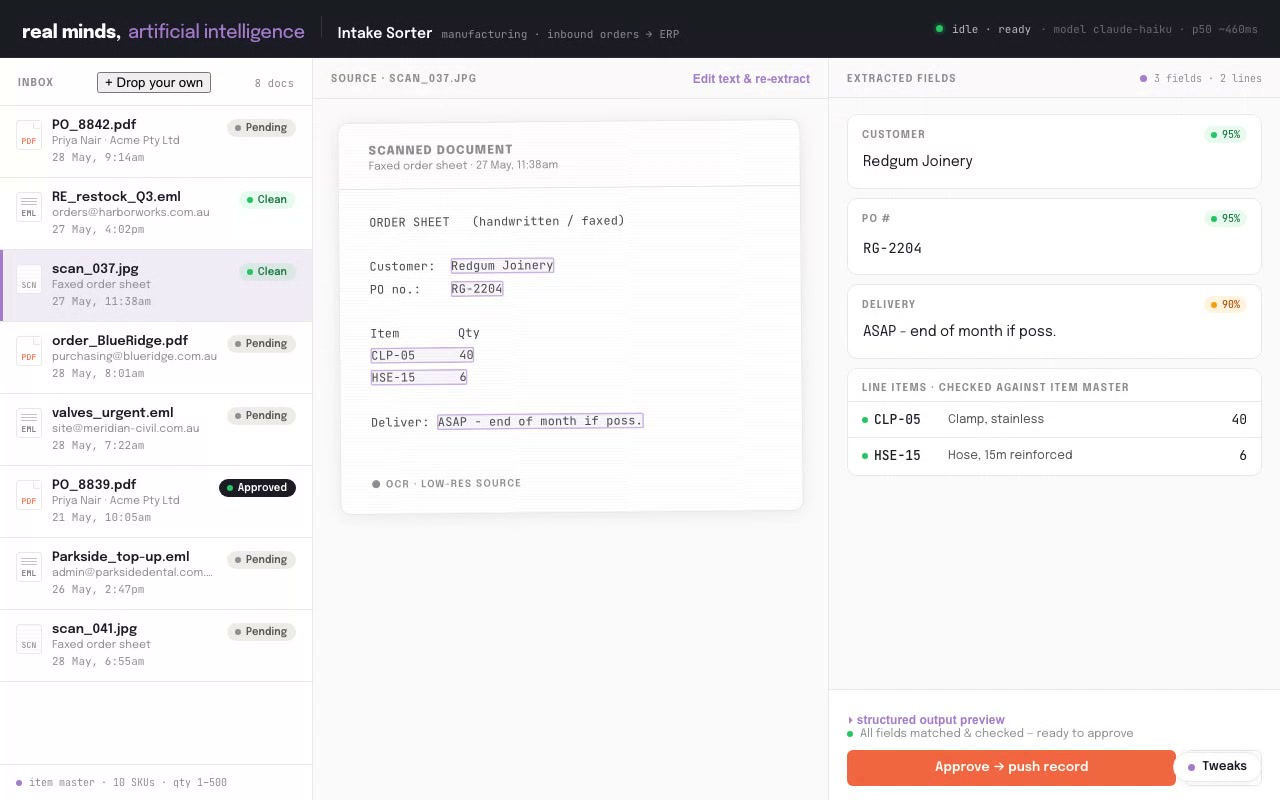
Brings enrolment processing from around 25 minutes per applicant to about 4.
Compliance Evidence Assembler

Drafts an ASQA/AVETMISS-style evidence pack against the regulator's template from records kept current, flagging every gap — so audit prep is review-and-sign-off, not a weekend of hunting.
Software that connects to AI
Find the integration path for Higher Education software.
Compare provider APIs, read/write access, MCP support, and practical integration difficulty.
Prompts you can use today, for free.
Sector-specific prompts RMAI uses as starting points. Copy one and run it against de-identified samples — or inside an approved private environment — to see the shape of the answer before you talk to us.
How RMAI would work with you.
Every engagement starts with the diagnostic and scales from there. These link through to how RMAI works.
What a defensible result looks like.
These are published third-party results — illustrative of the target RMAI builds toward, with a human in the loop throughout. They are not RMAI client claims, and the headline magnitudes re-baseline down to an independent 30–200-staff provider’s real volumes.
Facing the caps with the same headcount?
The two-week diagnostic is the right place to start. Fixed scope, fixed price. We’ll tell you whether the pattern fits and what the build would look like.