AI for agriculture, grounded in your own records and dockets.
AI for agriculture is grounded, auditable software that RMAI builds on your own records — compliance files, weighbridge dockets, spray diaries, and supplier invoices — so audit packs, reconciliation, and traceability are drafted, checked, and cited in minutes, with a human signing off every record.
What actually slows a primary-industry business down.
The binding constraints in agriculture are rarely the crop or the herd — they are operational: crushing compliance paperwork, manual reconciliation of dockets and invoices, and traceability records kept on paper then re-keyed. Each one is a documents-and-data problem carrying real market-access risk, which is exactly where grounded AI pays back.
Compliance paperwork is crushing margins and morale
Compliance now runs to about $213M a year across the Australian vegetable industry — roughly 4% of operating costs and 42% of average EBITDA — and two in five growers say they are weighing up leaving. Overlapping food-safety, labour, and market-access schemes pile the same evidence onto senior staff by hand.
Skilled hands are leaving while output hits records
Agricultural employment fell about 10% in a year to 247,000, even as the sector is forecast to a record $101.4bn. The scarce resource is no longer land or capital — it is skilled attention, and too much of it is spent on data entry and paperwork instead of on the farm.
The same figures re-keyed across disconnected spreadsheets
Australian digital agriculture is still "immature and ad hoc", so the same number lives in five places and none is trusted. Weighbridge dockets, grower details, and supplier invoices are typed in by hand, often late at night, then cross-checked across spreadsheets that don't talk to each other — in our own sector-diagnostic work, roughly two in three of these flows are still manual (indicative).
Traceability records are kept on paper, then re-keyed
NLIS livestock movements, spray diaries, and chemical batch numbers are mandatory and fined per breach, yet most are still recorded on paper and re-entered later. A single transcription slip can put market access at risk. Government has committed $46.7M to lifting national traceability.
What changes once the work is grounded in your own records.
The outcomes below are illustrative of patterns RMAI has shipped in other sectors — we have not yet shipped this for a named agribusiness client, so the figures are targets we build toward, not results from an agri deployment. We are looking for a founding agri client and will share the build risk to get there. Every pattern keeps a person on the final call — nothing finalises a record, an invoice, or a pay rate on its own.
The questions leaders ask first.
The questions below are the ones RMAI hears in the first call — on safety, staffing, compliance, cost, and feasibility.
What the time recovered is worth.
Move the sliders for your own volumes; the benchmark shows where shipped builds have landed.
| Task | Before | After |
|---|---|---|
| Compliance / audit-pack prep | ~half a day | < 1 hr (review) |
| Weighbridge ticket → invoice | re-keyed by hand | captured + matched |
| Supplier invoice handling | ~12 min each | exceptions only |
| Spray / traceability records | paper, then re-keyed | logged once, cited |
What RMAI has built for this sector.
The applications below are grounded, human-in-the-loop tools for this sector — some already built and shipped, some scoped from real briefs. Ask us which is which.
Weighbridge-to-Ledger Reconciler

Reads weighbridge dockets, matches each against the grower contract, and drafts the invoice in Xero — flagging missing tares, unwarranted shrink deductions, and price mismatches for a person to clear.
Spray-Diary Formatter

Turns informal field spray notes into a structured, APVMA-compliant chemical-application log — date, block, product, batch, rate, wind, operator, withholding period — quoting the source note and flagging any gap rather than inferring it.
PALM Piece-Rate Validator
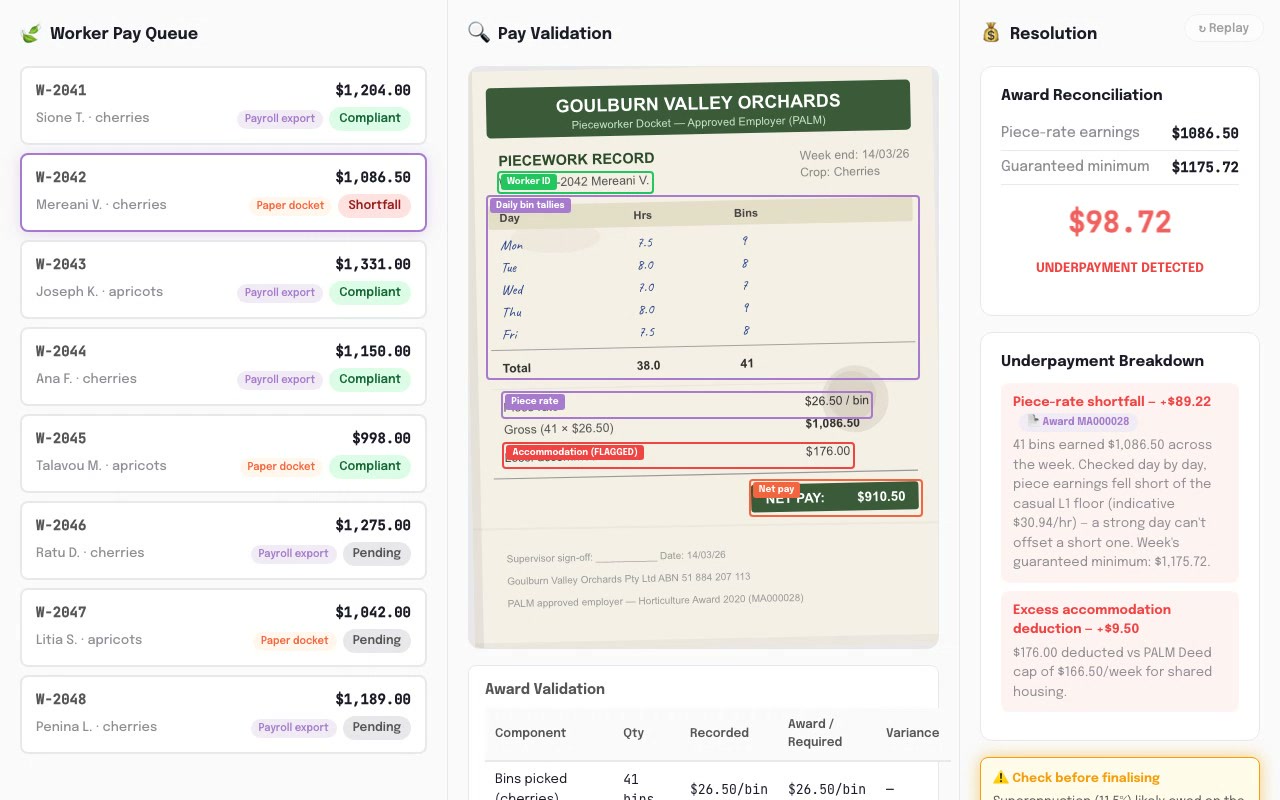
Takes harvest hours and units picked, calculates piece-rate earnings, checks them against the Horticulture Award minimum, and flags any picker owed a top-up before the run reaches payroll — with an audit-ready summary.
PaddockPro
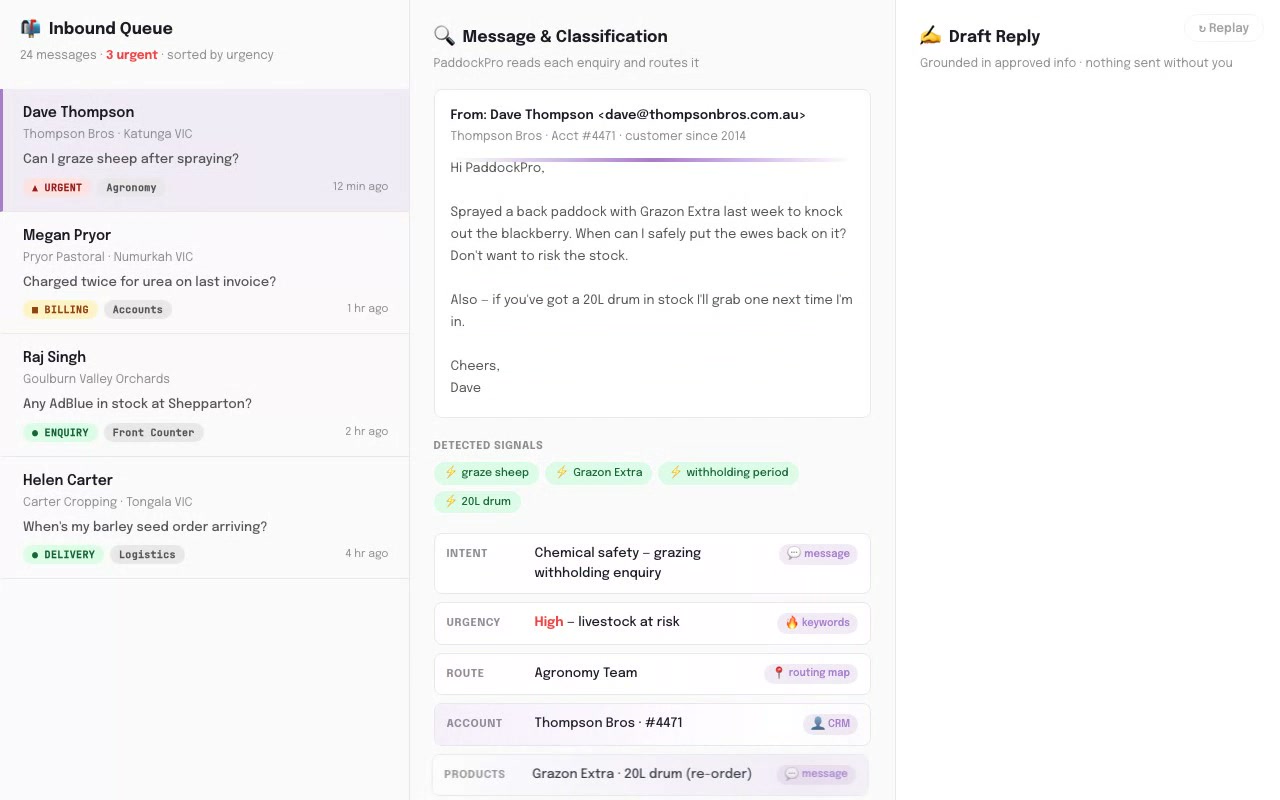
Answers ~60% of member helpline calls without escalation, with every answer traceable to a source document.
Audit-Pack Assembler

Watches the folders where spray diaries, water tests, and training certificates land, flags anything missing or expired, and assembles a Freshcare- or HARPS-ready evidence pack against the standard's checklist.
CoR-Evidence Monitor

Watches the driver logs, telematics, and maintenance records where Chain of Responsibility evidence lands, flags a fatigue, mass, or work-hour breach before an inspection finds it, and assembles an audit-ready evidence pack against the Heavy Vehicle National Law — surfacing exceptions for the compliance manager, never signing off on its own.
Batch Traceability & Recall Simulator

Maps lot and batch genealogy from raw-material receipt through production to customer shipments, tracing any lot forward to every affected product or backward to its source — with a simulation mode to run a mock recall and find traceability gaps before a real event.
Software that connects to AI
Find the integration path for Agriculture & Primary Industry software.
Compare provider APIs, read/write access, MCP support, and practical integration difficulty.
Prompts you can use today, for free.
Sector-specific prompts RMAI uses as starting points. Copy one and run it against de-identified samples — or inside an approved private environment — to see the shape of the answer before you talk to us.
How RMAI would work with you.
Every engagement starts with the diagnostic and scales from there. These link through to how RMAI works.
What a defensible result looks like.
These are published third-party results in comparable agribusiness operators — illustrative of the target RMAI builds toward, with a human in the loop throughout. They are not RMAI client claims.
Considering AI for your farm or processing operation?
The two-week diagnostic is the right place to start. Fixed scope, fixed price. We’ll tell you whether the pattern fits and what the build would look like.