Prove your impact in hours, not weeks — grounded in your own case notes and grant budgets.
Funders now pay for outcomes, not activity — yet the proof of those outcomes is buried in unstructured case notes, and every grant wants its acquittal in its own format. RMAI builds grounded software on your own case notes, grant budgets, and donor records so an outcome summary, an acquittal exceptions list, or a supporter reply is drafted, cited to its source, and waiting for a program manager to approve — instead of being hand-assembled over days.
Where a not-for-profit's week actually disappears.
Funders moved to paying for outcomes, and overnight the job became proving them. So your best program people read case notes and hand-build a different report for every funder; finance cross-matches spending to restricted buckets before each acquittal; and the shared inbox fills faster than anyone can sort it. The mission is fine — it’s the proving and the reconciling that eat the week, and demand keeps outrunning the people doing it.
Proving impact is now the job — and it's done by hand
Data and reporting for evidence-based decisions has rocketed to the sector's number-one priority, up from 17% in 2023, because funders increasingly fund outcomes rather than activity. But the outcomes live in unstructured case notes, and program managers still read them and copy figures into a master document over days, every reporting cycle.
Your most expensive people are acting as a manual bridge
Employee expenses are 55% of charity costs — the single biggest line — and rising nearly 10% a year, the steepest on record. Much of that time goes to exporting from one system and re-keying into the next, because donor, finance, and program data rarely line up without someone reconciling it by hand.
Demand is outrunning the frontline that triages it
Ask Izzy logged 8.5 million searches for help in 2025 — the highest on record — after a 30% jump in hardship searches the year before. Every enquiry in a shared inbox is still read, categorised, and answered by hand first, so a crisis request can sit behind a routine one and response times stretch to days.
Every grant wants its acquittal its own way
The Productivity Commission called the charity regulatory framework confusing and burdensome, with multiple Commonwealth and State regulators. Each funder sets its own categories, format, and deadline, so finance hand-matches spending to restricted buckets and chases credentials through folders before every acquittal and audit.
What changes once your outcomes are grounded in your own notes.
NFPs working with RMAI cut the report-assembly and acquittal grind and tighten their funder audit trail at the same time. The outcomes below are illustrative of patterns RMAI has shipped to mission-led organisations; every one keeps a program manager or finance lead on the final call — nothing is sent, filed, or acquitted on the AI’s say-so.
The questions leaders ask first.
The questions below are the ones RMAI hears in the first call — on safety, staffing, compliance, cost, and feasibility.
What the time recovered is worth.
Move the sliders for your own volumes; the benchmark shows where shipped builds have landed.
| Task | Before | After |
|---|---|---|
| Funder / board impact report | days–weeks | ~50% faster (review) |
| Shared-inbox supporter triage | 24–48 hr | drafted in minutes |
| Restricted-fund acquittal cross-match | ~½ day per grant | exceptions list, same-day |
| Grant-round shortlisting | panel reads 200+ | panel reads top ~30 |
What RMAI has built for this sector.
The applications below are grounded, human-in-the-loop tools for this sector — some already built and shipped, some scoped from real briefs. Ask us which is which.
Supporter Inquiry Triage

Reads each enquiry in a shared inbox, classifies intent and urgency, routes it to the right team, and drafts a values-aligned reply for staff to approve — so urgent requests surface first instead of waiting days behind routine ones.
Restricted-Fund Reconciler
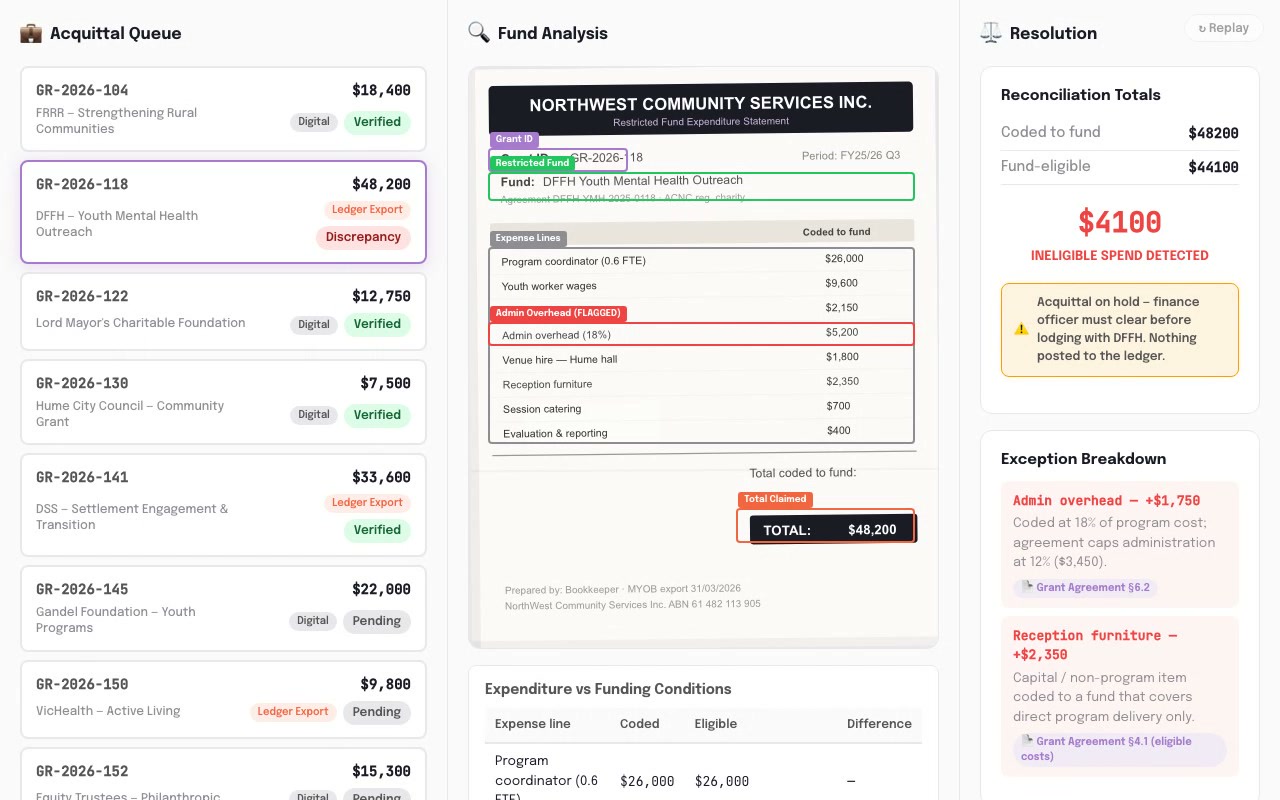
Matches program spending lines against each restricted grant's approved categories and budget, flags every line that doesn't map or that overspends, and hands finance an exceptions list to decide on — turning a manual cross-match into a short review.
Grant Application Reader

Pre-scores 200+ applications against the rubric so the panel meets on the top 30 only.
First-Gift Welcome Drafter

Spots first-time donors who haven't been thanked, drafts a warm, personalised welcome sequence tied to the program they actually gave to, and queues it for staff to approve and send — targeting the sector's weakest metric, first-year donor retention.
Donor Memory

Gives the relationship manager a 30-second briefing they used to spend an hour pulling together.
Case-Note Impact Synthesiser

Reads a de-identified case note against your own outcomes framework and drafts the structured entry — Star scores, goal progress, risk flags — with every value traced to its source, so a program manager reviews in an hour instead of retyping notes into report fields for days.
Submission Drafter

Read a grant round notice and its guidelines, then turn the requirements into a structured first-draft submission your grants officer reviews.
Policy Brief Drafter
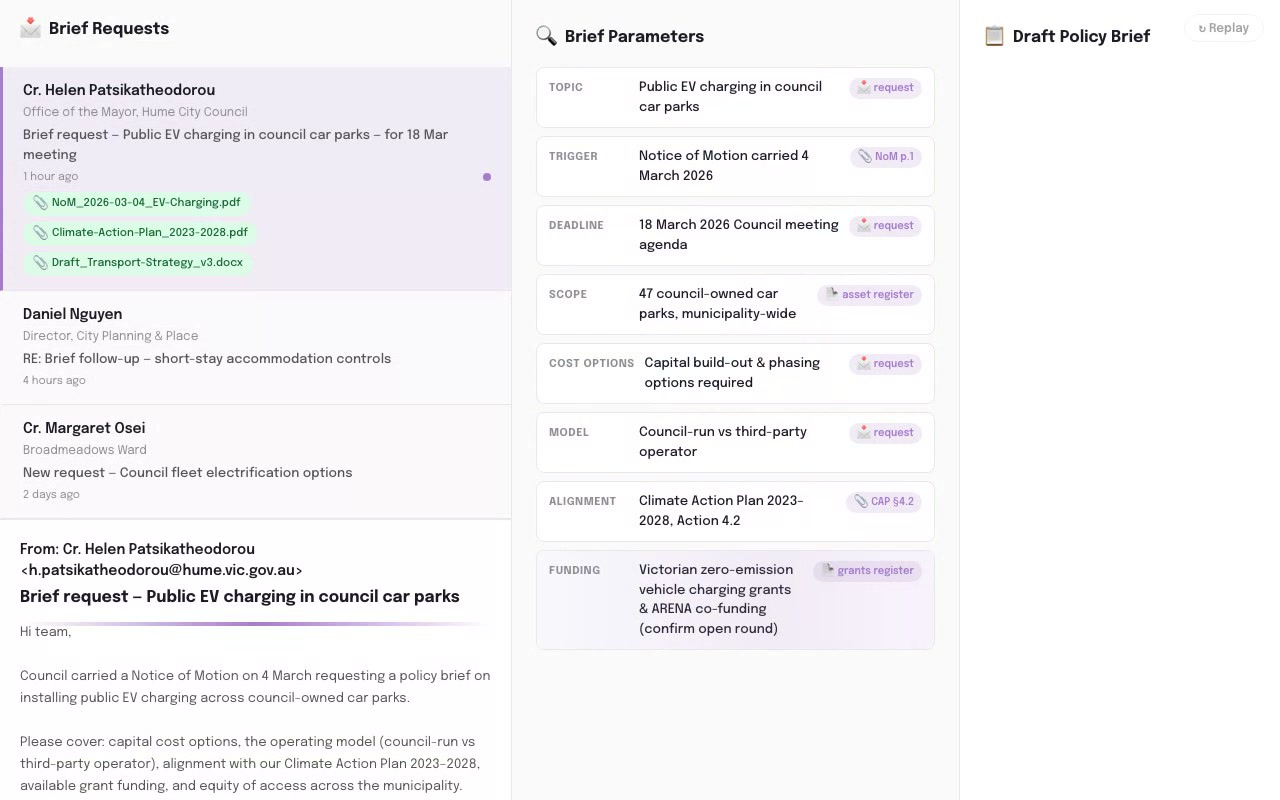
Turns a councillor's Notice of Motion and the attached background docs into a first-pass, costed policy brief with every figure traced to its source — in hours, not days.
PaddockPro
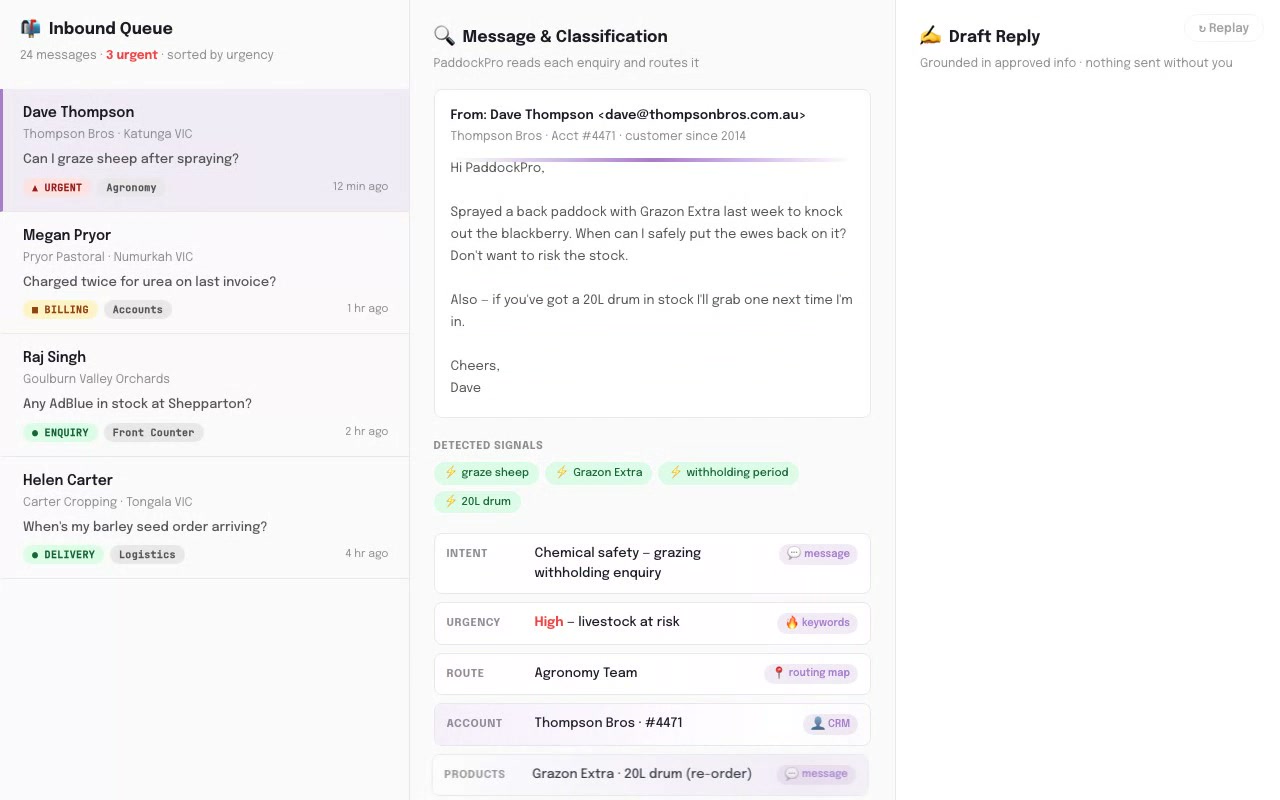
Answers ~60% of member helpline calls without escalation, with every answer traceable to a source document.
Inbox Triage

Turns a chaotic shared inbox into a sorted, urgency-ranked queue with drafted replies — so the morning starts with the work, not the sorting.
Grant Eligibility Checker
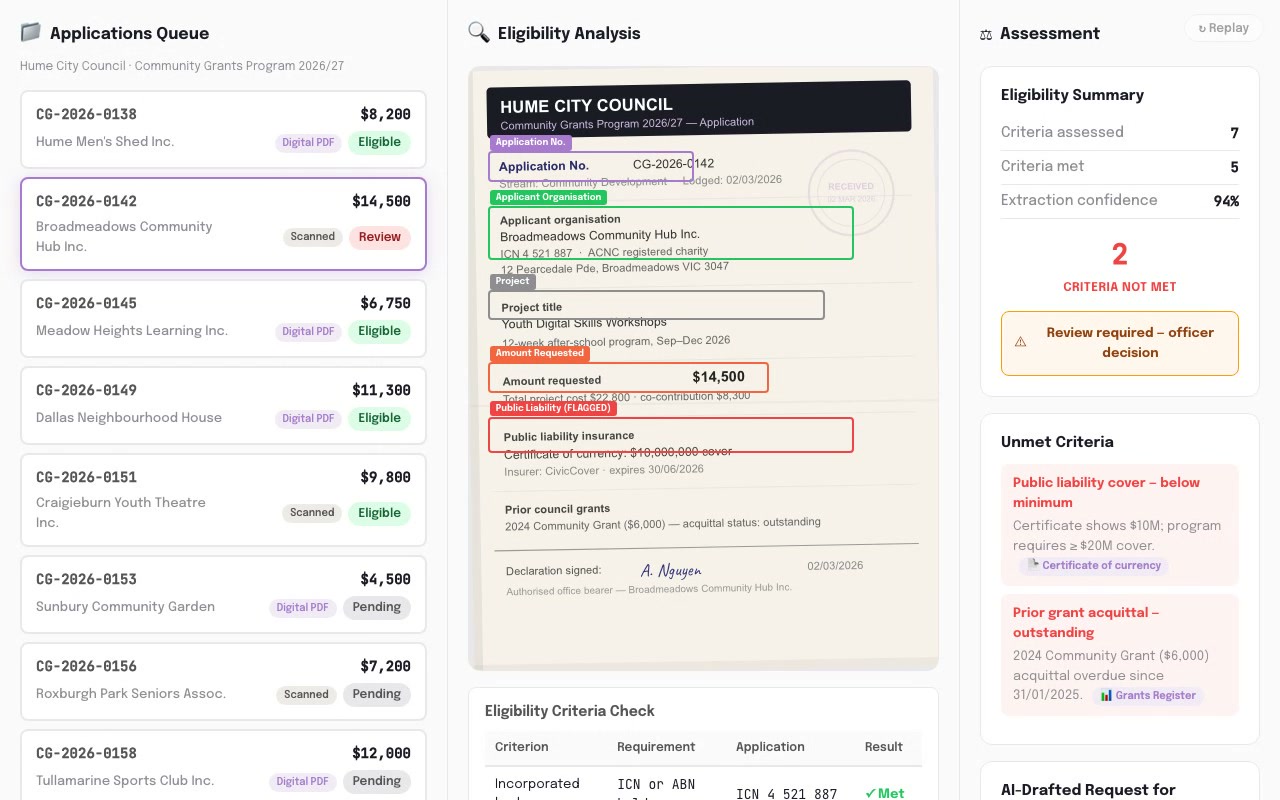
Removes ~40% of out-of-scope applications before they hit the assessor queue.
Consultation Submission Drafter

Turns a council or agency consultation notice plus your own prior submissions, policy positions and meeting resolutions into a structured, fully cited first draft — mapping each consultation question to a recorded position and flagging anything unrecorded for an officer to decide.
Software that connects to AI
Find the integration path for Not-for-Profit software.
Compare provider APIs, read/write access, MCP support, and practical integration difficulty.
Prompts you can use today, for free.
Sector-specific prompts RMAI uses as starting points. Copy one and run it against de-identified samples — or inside an approved private environment — to see the shape of the answer before you talk to us.
How RMAI would work with you.
Every engagement starts with the diagnostic and scales from there. These link through to how RMAI works.
What a defensible result looks like.
These are published third-party results in comparable nonprofits — illustrative of the target RMAI builds toward, with a human in the loop throughout. They are not RMAI client claims.
Spending more time proving the work than doing it?
The two-week diagnostic is the right place to start. Fixed scope, fixed price. We’ll tell you whether the pattern fits and what the build would look like.