HR & Payroll – Real Minds AI
Industry · HR & Payroll

AI for HR & payroll, grounded in your own awards and policies.

Turn award interpretation and pay runs into minutes, not days.
In one line

AI for HR & payroll is grounded, auditable software that RMAI builds on your own awards, policies, and pay data — so award interpretation, timesheet reconciliation, and the same repetitive HR queries are drafted, checked, and cited in minutes, with a human signing off every pay run.

Last updated 1 June 2026·TA reviewed by Tracy Anthony, principal · RMAI
01The situation

What actually slows an HR and payroll team down.

The biggest constraints in HR & payroll are not strategic — they are operational: complex award interpretation, manual timesheet reconciliation, and a flood of repetitive queries, all carrying real compliance risk. Each one is a documents-and-data problem, which is exactly where grounded AI pays back.

1 in 5payrolls

Pay errors quietly drive people out the door

One in five pay runs carries an error, and HR and payroll wear the rework. Two pay mistakes are enough to send roughly half of staff looking for another job — so a small data-entry slip becomes a retention problem.

· EY 2022 payroll survey (US); UKG Workforce Institute (US)
$358M recovered

Award underpayment is now a criminal offence

From 1 January 2025 intentional wage underpayment is a crime in Australia, with directors personally exposed. The Fair Work Ombudsman recovered $358 million for 249,000 underpaid workers in one year — most of it from manual award interpretation getting penalties, loadings, and super wrong.

· Fair Work Ombudsman Annual Report 2024–25
57% of the week

HR spends most of its time on admin, not people

Award questions, the same fifty Monday queries, manual forms, and statutory reporting fill the week. The bottleneck is not the team's judgement — it is their attention, spent re-answering and re-keying instead of on hiring, retention, and compliance.

· Deloitte 'Modernizing HR', via Deel 2025 (indicative)
~2days/run

Pay runs start with days of manual reconciliation

Hours arrive as paper sheets, app notes, and spreadsheets, then get re-keyed and cross-checked against award rates by hand. Time, leave, pay, and HRIS data never line up, so every pay run begins as detective work.

· operator interviews; consistent with Neo Intelligence's published 2-day baseline
02The value

What changes once payroll is grounded in your own awards.

Teams working with RMAI recover senior-staff hours and tighten their audit trail at the same time. The outcomes below are illustrative of shipped patterns; every one keeps a person on the final call — nothing finalises pay on its own.

< 1hr
Weekly pay run, reviewed not rebuilt
Down from ~2 days. Verified hours feed an award-interpretation check; the payroll officer reviews exceptions and signs off, instead of re-keying timesheets against rate tables by hand.
30–60%
Routine HR queries self-served
A grounded assistant answers PTO, policy, and pay questions from your own handbook and awards, with citations; HR handles the genuine exceptions instead of the Monday flood.
100%
Auditable trail on every pay run
Every rate, penalty, and super line is calculated against the current award and logged with its source, so a Fair Work or ATO query is answered from records — not reconstructed under pressure. A person still signs off.
03FAQs

The questions leaders ask first.

The questions below are the ones RMAI hears in the first call — on safety, staffing, compliance, cost, and feasibility.

RMAI tools draft, check, and sort; people decide. What gets automated is the drudgery — award interpretation, timesheet reconciliation, the same fifty Monday questions — not the judgement. In a 2024 Gartner survey, 67% of HR leaders planned no new roles for it, and organisations that cut headcount for AI did not see better returns. The gain is reclaimed capacity, and a human signs off every pay run.
Yes — when it is scoped correctly. RMAI builds inside your own tenancy (Microsoft 365, your HRIS, your payroll system); your data is not used to train third-party models, and the assistant only sees the documents you point it at. Personal information can be redacted before processing, access is role-based, and every answer is cited to its source for review.
It makes compliance a by-product, not a scramble. Since 1 January 2025 intentional underpayment is a criminal offence, and the ATO data-matches STP Phase 2 against super and BAS. RMAI tools check each run’s rates, penalties, and super against the current award and flag mismatches before payday, with an audit trail showing how every figure was reached. A named person still approves.
Only with a human in the loop — which is exactly how RMAI builds it. The AI flags the things a tired person misses at 5pm on pay day: an unusual overtime spike, a misclassified casual, a missing break, a super gap. It is strong at high-volume, rules-shaped checks, and it never silently finalises pay — the final sign-off stays with your team.
RMAI always starts with a fixed-price AI working session ($4,500, credited against the build) that tells you whether the pattern fits before any build. A focused build typically ships in 3–6 weeks in the $10k–$60k AUD band — far short of a 12–18 month enterprise rollout. Most of the work is already done: these tools are skins of patterns RMAI has shipped before, so a smaller team pays for the bespoke ~30%, not a platform.
04ROI

What the time recovered is worth.

Move the sliders for your own volumes; the benchmark shows where shipped builds have landed.

Estimate · drafting + triage time recovered
Documents handled / month160
Minutes saved / document15
Loaded staff cost / hour$50
$24,000 AUD / year
480 senior-staff hours returned each year. Directional — we firm this up in the diagnostic.
Benchmark · per-task, shipped builds
before → after
TaskBeforeAfter
Weekly pay run (reconcile + award check)~2 days< 1 hr
Tier-1 employee queriesall to HR30–60% self-served
Onboarding admin per hire~5 hrsminutes
Award / underpayment checkfound in auditflagged pre-payday
05Applications

What RMAI has built for this sector.

The applications below are grounded, human-in-the-loop tools RMAI has built or scoped for this sector — illustrative of the patterns we ship.

STP Phase 2 Category Auditor

Audits pay-category mappings against ATO STP Phase 2 income types and flags generic or high-risk codes before lodgement — heading off correction events and audits.

build est. · 2–3 weeks

Timesheet-to-Payroll Reconciler

Pulls approved hours into the pay run and flags overtime spikes, missing breaks and absent clock-offs for review — turning a two-day reconcile into an hour.

build est. · 3–5 weeks

Tier-1 HR Query Assistant

Answers staff leave, pay and policy questions from your own handbook, enterprise agreement and awards — quotes the clause it relied on, and routes anything not in the documents to a person.

build est. · 2–4 weeks

Award Rate Checker

Reconciles every payslip line against the modern award before the pay run leaves, so an underpaid weekend penalty or missed allowance gets caught — and corrected — before it becomes a wage-theft exposure.

build est. · 3–4 weeks

Also useful here

PALM Piece-Rate Validator

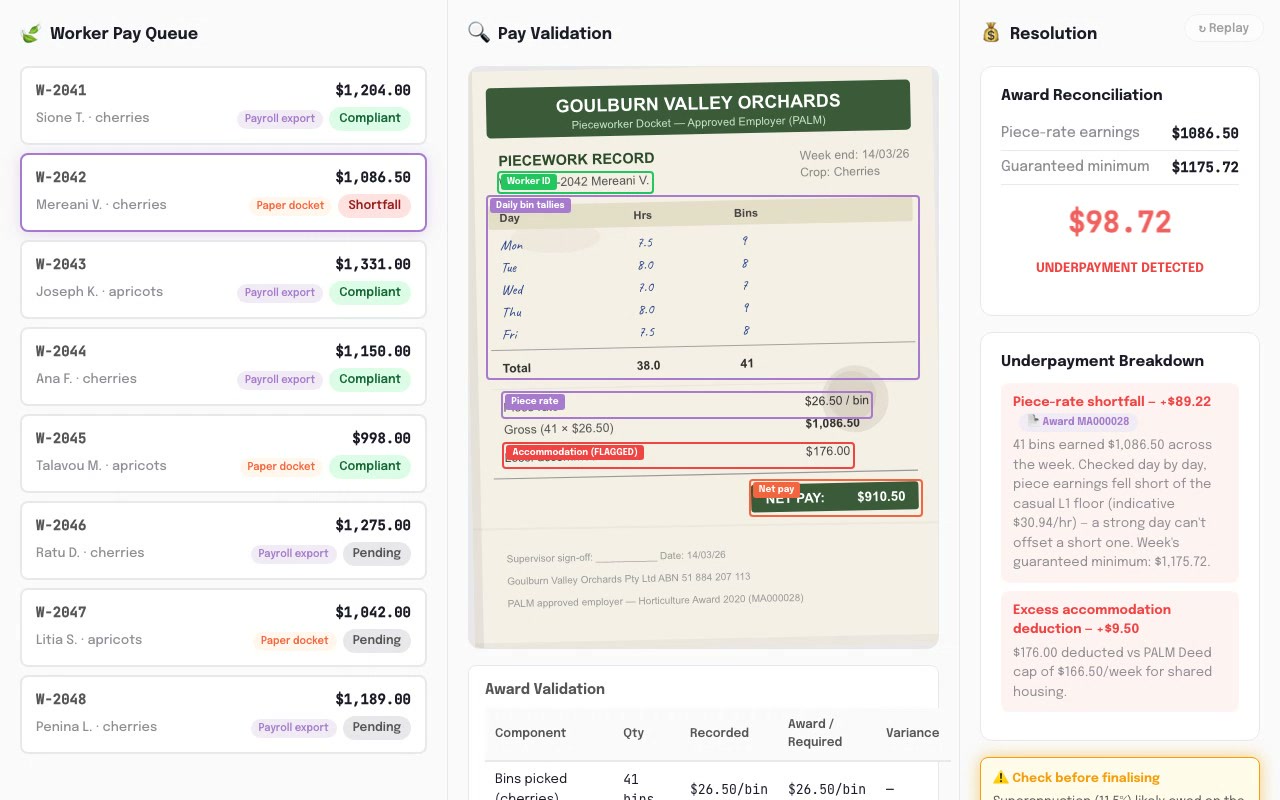
Takes harvest hours and units picked, calculates piece-rate earnings, checks them against the Horticulture Award minimum, and flags any picker owed a top-up before the run reaches payroll — with an audit-ready summary.

build est. · 3–4 weeks

06Prompts

Prompts you can use today, for free.

Sector-specific prompts RMAI uses as starting points. Copy one, run it against your own documents in any assistant, and see the shape of the answer before you talk to us.

Award rate check
Review these payslip line items against the modern award clause below. Flag any base rate, penalty, loading, allowance, or super that looks non-compliant, and cite the exact clause for each flag. Do not finalise anything — output for a human to review. Leave a field blank rather than guessing if the award text does not cover it.
Timesheet anomalies
Compare these recorded hours against the roster and our overtime rules. List every discrepancy that affects pay — shifts over the overtime threshold, missing breaks, absent clock-offs — and mark which need a decision. Output for human review only; do not adjust pay.
Policy answer
An employee asks: "{question}". Answer using only our policy handbook text below. Quote the relevant section and give its heading and date. If the answer is not in the text, say so and route the question to HR rather than inferring.
STP Phase 2 audit
Classify each of these pay categories into the correct ATO STP Phase 2 income type (gross, overtime, allowance — name the type, bonus/commission, salary sacrifice, lump sum). Flag any generic mapping such as "other allowance" as high risk. Present the result as a table and cite the ATO definition you used.
08Proof

What a defensible result looks like.

These are published third-party results in comparable Australian operators — illustrative of the target RMAI builds toward, with a human in the loop throughout. They are not RMAI client claims.

80–90%
less time on weekly payroll reconciliation, in published Australian award-automation case studies
AU steel-fixing & formwork subcontractorsTwo-day manual reconciliation cut to about an hour; one reported over $150k a year in saved admin · Neo Intelligence case studies (SG Formwork, GVK) — vendor-reported
Deloitte AustraliaForm-recognition AI analysed 3.2M+ payslip records and 15,000+ casuals for underpayment, with human oversight throughout · Deloitte Australia, 2023
isolved People Cloud — SMB study201% three-year ROI, 7.2-month payback, and 70–88% less time on payroll processing · Nucleus Research, commissioned by isolved — independent NASBA methodology (US SMB study)

Considering AI for your HR and payroll team?

The two-week diagnostic is the right place to start. Fixed scope, fixed price. We’ll tell you whether the pattern fits and what the build would look like.

Events Assessment Proof Talk to us
Ask us anything