AI for law firms, grounded in your own matter files, precedents, and playbooks.
AI for small and mid-size Australian law firms and in-house teams is grounded, auditable software that RMAI builds on your own matter files, precedents, and playbooks — so first-pass document and contract review, matter intake and conflict checks, evidence chronologies, pre-bill scope-and-rate checks, and precedent lookups are drafted, checked, and cited to their source in minutes, with an admitted practitioner reviewing and signing off every result. Grounded on your documents, never a public chatbot inventing case law.
What actually leaks money in a small or mid-size firm now.
It is not the lawyering — it is everything around it. Five of every eight hours are non-billable, costs are climbing faster than the hours you can charge, a document-heavy matter swallows a fortnight before anyone forms a view, and intake, conflicts and costs disclosure ride on records scattered across email, drives and people’s heads. None of these is a legal-judgement problem; each is a documents-and-records problem — the gap between your DMS, your inbox, and your practice system — which is exactly where grounded AI earns its place.
Five hours of every eight are non-billable — and that is where the leak is
Australian firms set daily targets of roughly 5.5–7 billable hours, but actual utilisation runs nearer 30–40% — about three billable hours captured in an eight-hour day. The other five disappear into reading, document management, intake, chasing files, and admin. On the billable-hour model that is your single biggest revenue leak: not bad lawyering, but skilled time spent on work nobody can charge for. The chokepoint is the non-billable first pass, and it is exactly the mechanical work grounded AI can draft for a lawyer to check.
Costs are accelerating faster than the hours you can bill
Across the Australian market, direct expenses ran at roughly +9.7% while lawyers logged about the same monthly hours as the year before and utilisation was effectively flat (+0.2%) — so margin gets squeezed from both ends (Thomson Reuters, Australia mid-year update 2025). When you cannot lift chargeable hours, the lever that is left is taking the non-billable load off the people you already have, without adding headcount.
A document-heavy matter eats a fortnight before the thinking starts
On a dispute spread across 50-plus emails, contracts, variations, progress claims and file notes, building one reliable, dated, source-linked chronology is days to a fortnight of low-judgment transcription billed at the wrong rate — or written off. Discovery is a continuing obligation, so it gets re-done as documents arrive. The reconstruction is mechanical; deciding what the sequence means is the lawyer's, and that is where the recaptured time should go.
Intake, conflicts and costs disclosure ride on records that don't talk
Every new matter must clear a conflict check against a current register, and once costs are likely to exceed $750 (ex GST and disbursements) written costs disclosure is required under the Legal Profession Uniform Law — yet enquiries land across email, web forms and phone notes and get re-keyed by hand. A stale conflict register is the one failure that carries real conduct consequence, and a slow first response loses the matter. The signals are scattered; the obligation is not.
What changes once the mechanical work runs on your own files.
The aim is to get non-billable hours back and tighten the conduct trail at the same time. The outcomes below are illustrative of the patterns RMAI builds — not results from a named legal client — and each keeps an admitted practitioner on the final call: no advice given, no contract cleared, no chronology treated as fact, and no bill sent, on its own.
The questions leaders ask first.
The questions below are the ones RMAI hears in the first call — on safety, staffing, compliance, cost, and feasibility.
What the time recovered is worth.
Move the sliders for your own volumes; the benchmark shows where shipped builds have landed.
| Task | Before | After |
|---|---|---|
| First-pass document / contract review | 1–2 hrs/doc by hand | 30–50% reclaimed (review) |
| Evidence chronology (50+ docs) | days to a fortnight | drafted in an afternoon, solicitor approves |
| Matter intake + conflict check | re-keyed across systems | classified & checked, person signs |
| Pre-bill scope / rate review | skimmed or skipped | every line checked, owner clears |
What RMAI has built for this sector.
The applications below are grounded, human-in-the-loop tools for this sector — some already built and shipped, some scoped from real briefs. Ask us which is which.
Scope & Billing Guardian

Reviews each draft invoice against the engagement letter scope and agreed rate card before it goes out — flagging out-of-scope work, rate variances and non-billable time, and drafting the adjustment note for the engagement owner to clear.
Quote Drafter

Turn an inbound request for quote into a priced first-pass draft in minutes, built from your own prior quotes and house pricing rules.
Precedent & Knowledge Finder
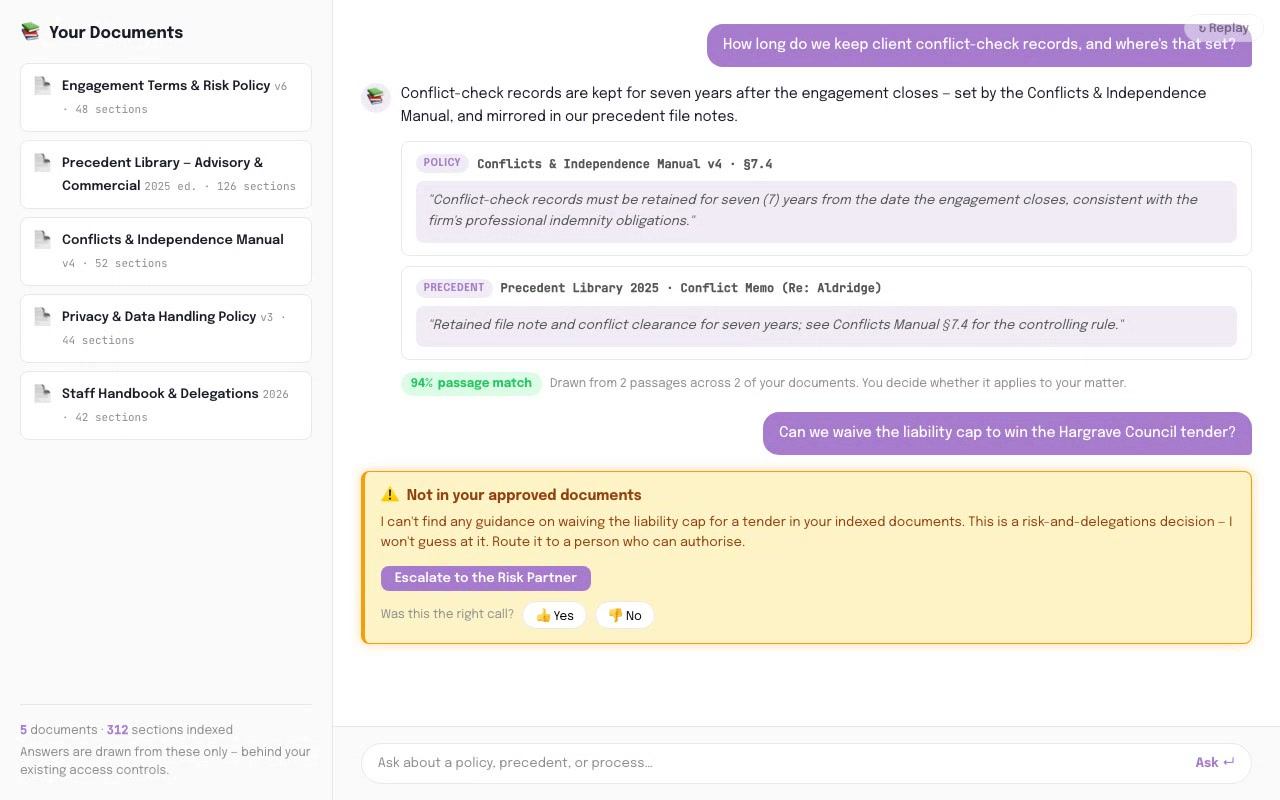
A fee-earner asks a question in plain language and gets the answer from your own precedents, advice, policies and matter files — with the exact document, version and clause quoted, and an honest "not on file" when it isn't there.
Inbox Triage

Turns a chaotic shared inbox into a sorted, urgency-ranked queue with drafted replies — so the morning starts with the work, not the sorting.
Engagement Intake & Routing Desk

Reads each inbound enquiry, extracts the client and matter details, classifies the request, runs a conflict check, drafts a holding reply, and routes it to the right team — for a person to review before anything is sent.
Contract Clause Review

First-pass triage of an inbound contract against your firm's playbook — every clause classified, the risky ones flagged with a suggested redline, before a lawyer opens the document.
Evidence Chronology Builder

Turn a pile of 50+ emails, contracts, invoices and file notes into a dated, source-linked chronology your lawyer can actually rely on — in an afternoon, not a fortnight.
Software that connects to AI
Find the integration path for Legal software.
Compare provider APIs, read/write access, MCP support, and practical integration difficulty.
Prompts you can use today, for free.
Sector-specific prompts RMAI uses as starting points. Copy one and run it against de-identified samples — or inside an approved private environment — to see the shape of the answer before you talk to us.
How RMAI would work with you.
Every engagement starts with the diagnostic and scales from there. These link through to how RMAI works.
What a defensible result looks like.
These are illustrative of the patterns RMAI builds toward, with an admitted practitioner reviewing and signing off every output. They are not RMAI client guarantees; magnitudes re-baseline to a small/mid AU firm’s real matter volumes. Regulatory items are sourced; figures we could not independently verify for the AU market are labelled indicative.
Losing five hours in eight to non-billable work?
The two-week diagnostic is the right place to start. Fixed scope, fixed price. We’ll tell you whether the pattern fits and what the build would look like.