Quote in hours, not days — with your scarce people pricing the job, not typing it.
Your estimators spend most of their day reading drawings and re-keying line items instead of pricing the job — and you can’t hire your way out, because barely half of advertised trades vacancies get filled. RMAI builds grounded software on your own drawings, RFQs, SOPs, and supplier invoices, so the quote, the order, the three-way invoice match, and the shop-floor fault-find are drafted and cited in minutes — and your scarce people sign off, instead of typing.
What actually slows a manufacturing business down.
In a 30–80 person shop the bottleneck is rarely the machines or the craft — it’s the desk work wrapped around them. The RFQ that sits for three days because the estimator is buried in drawing packs. The order re-keyed across an ERP, a planner’s spreadsheet, and a despatch sheet that were never built to talk. The supplier invoices matched by hand at month-end. The one fitter everyone queues at for a fault no manual covers. And you can’t staff your way past any of it — barely half of trades vacancies get filled.
Your estimator types for hours, then prices for minutes
Reading the email, extracting specs off the drawing pack, hunting old quotes for a price reference, re-keying it into the ERP — that is most of an estimator's day. The 20–45 minutes of actual pricing judgement, the part only they can do, is the smallest slice. So the quote lands three days late and the faster shop has already won the job.
A person is the bridge between your ERP and everything else
The PO lands by email, gets typed into the ERP, copied into a planning spreadsheet, then again into the despatch sheet — because none of them talk. Hand-keying runs a 1–3% error rate, and one transposed quantity or ship date becomes a short shipment, a rework, or a chargeback weeks later.
You can't hire your way out of this
Only 54% of advertised trades and technical vacancies get filled — the lowest of any skill group, and machinists, fitters, and fabricators are all on the national shortage list. So when a 35-year fitter retires, the fault-finding and quoting know-how in their head walks out the gate, and there is no replacement to teach it to.
Every supplier invoice gets matched by hand, line by line
Someone opens the invoice, the PO, and the goods-receipt note in three windows and reconciles them line by line at $12–30 an invoice — pure rules work. The mismatched price and the missing credit that should block payment are exactly what a tired person at end-of-month misses, and the margin leaks out quietly.
What changes once the drudgery comes off your estimators and fitters.
Manufacturers working with RMAI get the typing, matching, and document-hunting off their scarce people, so a smaller team quotes faster and the audit trail tightens at the same time. The figures below are illustrative of patterns RMAI has shipped; every one keeps a person on the final call — no quote is sent and no invoice is posted without someone signing off.
The questions leaders ask first.
The questions below are the ones RMAI hears in the first call — on safety, staffing, compliance, cost, and feasibility.
What the time recovered is worth.
Move the sliders for your own volumes; the benchmark shows where shipped builds have landed.
| Task | Before | After |
|---|---|---|
| RFQ turnaround (extract + draft quote) | 3–5 days | < 8 hr (review) |
| Supplier invoice (three-way match) | $12–30/invoice | $1–5/invoice |
| Order intake from email / PDF | re-keyed by hand | exceptions only |
| Troubleshooting / SOP lookup | ask the one expert | cited answer in minutes |
What RMAI has built for this sector.
The applications below are grounded, human-in-the-loop tools for this sector — some already built and shipped, some scoped from real briefs. Ask us which is which.
Supplier-Invoice Reconciler

Matches each supplier invoice against its purchase order and goods-receipt note, flags price variances, quantity mismatches, and missing credits, and routes the exceptions for a person to clear — never posting to the ledger itself.
Shop-Floor SOP Copilot

Answers shop-floor SOP, machine-setup and troubleshooting questions from your own approved manuals, work instructions and fault history — citing the source document and section on every step, and refusing when the documents don't cover it, so new starters stop queueing for the one veteran fitter.
RFQ-to-Quote Copilot

Parses an incoming RFQ — email, web form or PDF — into materials, quantities and specs, checks them against your bill-of-materials and lead times, and drafts a structured quote, flagging spec gaps for the estimator to resolve before it reaches the customer.
Quote from Engineering Drawings
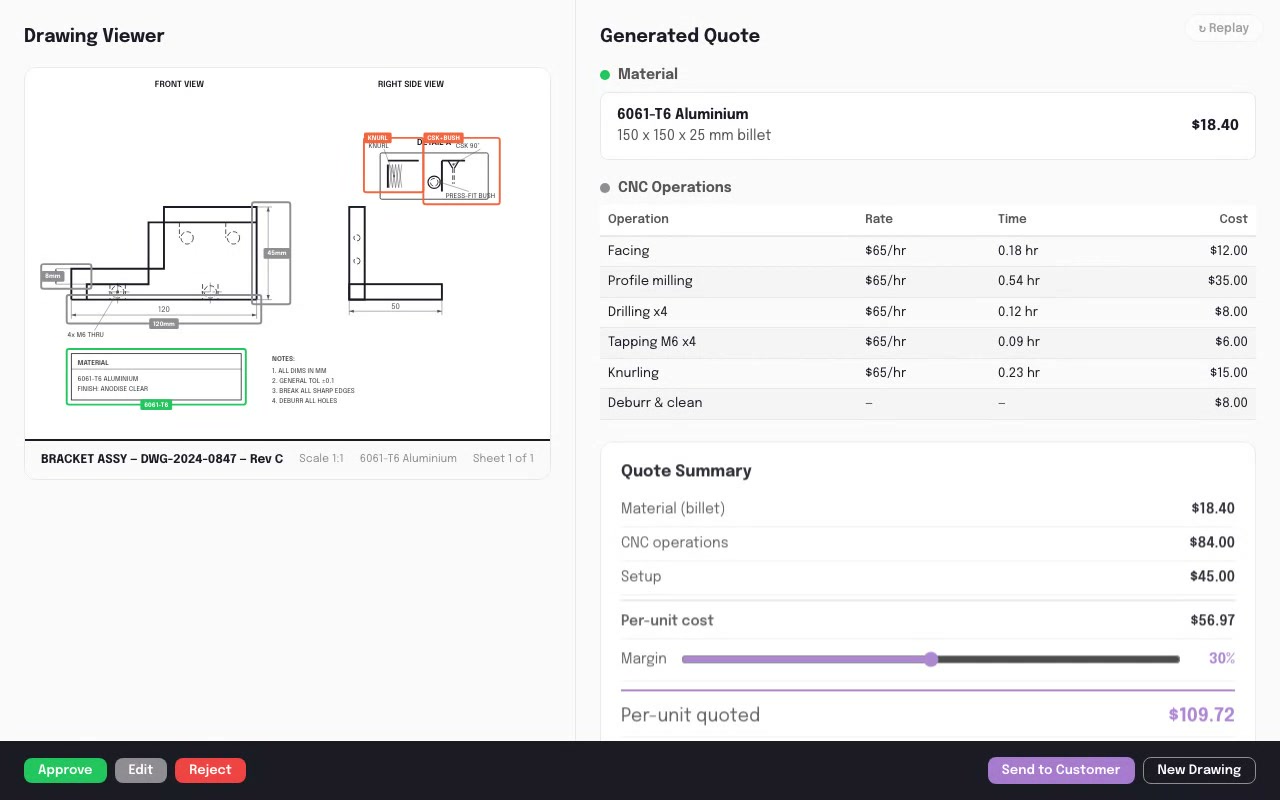
Extracts dimensions, tolerances, materials and operations from engineering drawings, prices them against the workshop's rate card, and drafts a quote — so the estimator checks the takeoff against the drawing and approves before it goes out.
Order Intake Sorter

Reads inbound customer orders arriving as email text and varied PDFs, extracts them into ERP-ready fields, and flags any mismatch against your item master — landing a clean, reviewable record instead of a re-keyed one.
Warranty-Claim Drafter

Reads the repair order and technician notes, drafts the OEM warranty claim with failure, defect and labour codes, and flags missing information — for a warranty clerk to check and submit.
Service-Knowledge Concierge

Answers a technician or advisor's question from your own repair manuals, SOPs and right-to-repair data, with a citation for every answer — and says so when the answer isn't in the library rather than guessing.
RFI Triage Desk

Reads each incoming RFI, finds the relevant spec and drawing, drafts a first-pass answer with source links, flags duplicates and overdue items, and routes it to the right person — who reviews and approves before anything goes back.
Recall War Room

Traces an affected lot forward through production and shipments to scope a recall, drafts the customer and retail notification list, and builds the action log — with a recall coordinator approving each stage before any notification is sent.
Quote from Architectural Plans

Reads architectural drawings, takes off the quantities — floor areas, wall lengths, window and door schedules — prices them against your rate card, and drafts a quote for the estimator to check against the plans and approve before submission.
Quote Drafter

Turn an inbound request for quote into a priced first-pass draft in minutes, built from your own prior quotes and house pricing rules.
Project Knowledge Assistant

Ask a question and get the answer straight from the firm's own specs, head contract, ITPs, and standards — with the source passage, a link, and a confidence flag — instead of interrupting whoever last touched the file.
Parts-Invoice Reconciler

Matches each vendor parts invoice against the repair order and core-return log, flags price variances, missing credits and uncredited cores, and routes the exceptions for a person to clear — never adjusting the ledger itself.
Order Inbox Drafter

Reads orders arriving by email, PDF, voicemail, and text, extracts the line items, matches each to your SKU master, and produces a structured draft sales order — flagging anything ambiguous for a person to approve, never posting an order on its own.
Contract Clause Review

First-pass triage of an inbound contract against your firm's playbook — every clause classified, the risky ones flagged with a suggested redline, before a lawyer opens the document.
Software that connects to AI
Find the integration path for Manufacturing software.
Compare provider APIs, read/write access, MCP support, and practical integration difficulty.
Prompts you can use today, for free.
Sector-specific prompts RMAI uses as starting points. Copy one and run it against de-identified samples — or inside an approved private environment — to see the shape of the answer before you talk to us.
How RMAI would work with you.
Every engagement starts with the diagnostic and scales from there. These link through to how RMAI works.
What a defensible result looks like.
These are published third-party results in comparable manufacturers — illustrative of the target RMAI builds toward, with a human in the loop throughout. They are not RMAI client claims. iOrthotics is an automation and additive-manufacturing case (the closest measured Australian SME proxy), not a generative-AI deployment.
Quotes stuck for days, or knowledge walking out the door?
The two-week diagnostic is the right place to start. Fixed scope, fixed price. We’ll tell you whether the pattern fits and what the build would look like.