AI for government agencies & councils, grounded in your own policy library and prior submissions.
AI for government agencies and councils is grounded, auditable software RMAI builds on an organisation’s own policy library, prior submissions, and documentary record — so the submission drafting, briefing, knowledge search, and FOI work that fills an officer’s week is drafted, cited, and audit-ready in hours, with a named officer signing off every output.
What actually slows a government or civic organisation down.
Under capped rates and shrinking grants, the binding constraints are rarely the policy work itself — they are operational: consultation submissions assembled by reading years of scattered documents, briefings that demand a traceable chain from prior decisions, knowledge that walks out the door with the staff who hold it, and FOI requests that spike without warning. Each one is a documents-and-data problem, which is exactly where grounded AI pays back.
Repetitive admin eats an hour out of every day
Summarising long documents, searching for the right precedent, and drafting the same kinds of response run hundreds of times a week. The binding constraint is not the team's judgement — it is their attention, spent on rote document work instead of advice, casework, and constituents.
Submissions and briefings are built by reading scattered documents
Every consultation response or ministerial briefing has to demonstrate a traceable line from prior positions and decisions to the current one. That evidence lives across old submissions, board resolutions, and policy papers, and someone has to read all of it before the window closes.
Institutional knowledge is locked in files and staff tenure
The submission that set a position, the memo that resolved a disputed interpretation — this material is in the archive but findable only by people who remember it is there. When those people rotate or leave, the organisation re-litigates questions it already settled.
FOI still runs on spreadsheets in small governance teams
Freedom of Information and records requests mean locating, reviewing, and classifying documents against exemption frameworks — and most agencies still track it in Excel rather than a case-management system. The search is manual, the review is careful, and the volume spikes without warning.
What changes once the policy work is grounded in your own documentary record.
Government and civic organisations working with RMAI compress submission cycles and make institutional knowledge findable by any staff member — not just the ones who remember where it lives. The outcomes below are illustrative of patterns RMAI has shipped; every one keeps an officer on the final call.
The questions leaders ask first.
The questions below are the ones RMAI hears in the first call — on safety, staffing, compliance, cost, and feasibility.
What the time recovered is worth.
Move the sliders for your own volumes; the benchmark shows where shipped builds have landed.
| Task | Before | After |
|---|---|---|
| Consultation submission first draft | 3–5 days officer time | 1 day (review) |
| Policy / precedent search | hours / ask the senior | instant cited answer |
| FOI document classification | half-day manual search | < 2 hrs |
| Re-keying between systems | 5–10 min per item | seconds |
What RMAI has built for this sector.
The applications below are grounded, human-in-the-loop tools for this sector — some already built and shipped, some scoped from real briefs. Ask us which is which.
Submission Drafter

Read a grant round notice and its guidelines, then turn the requirements into a structured first-draft submission your grants officer reviews.
Policy Precedent Finder

Ask "what is our position on this, and who can sign it off?" and get a plain-language answer cited to the exact delegation clause and prior decision — so the knowledge that walks out when a long-serving officer leaves stays on the record.
Policy Brief Drafter
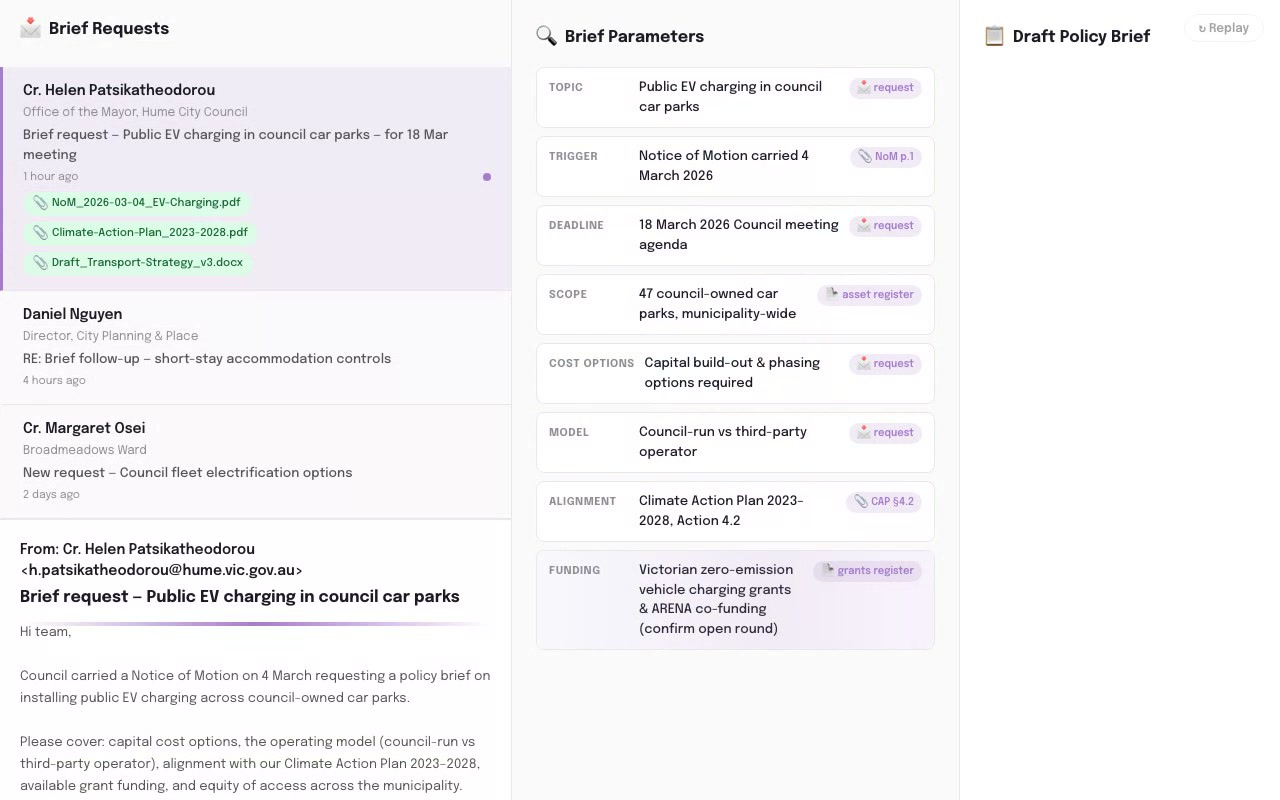
Turns a councillor's Notice of Motion and the attached background docs into a first-pass, costed policy brief with every figure traced to its source — in hours, not days.
Grant Eligibility Checker
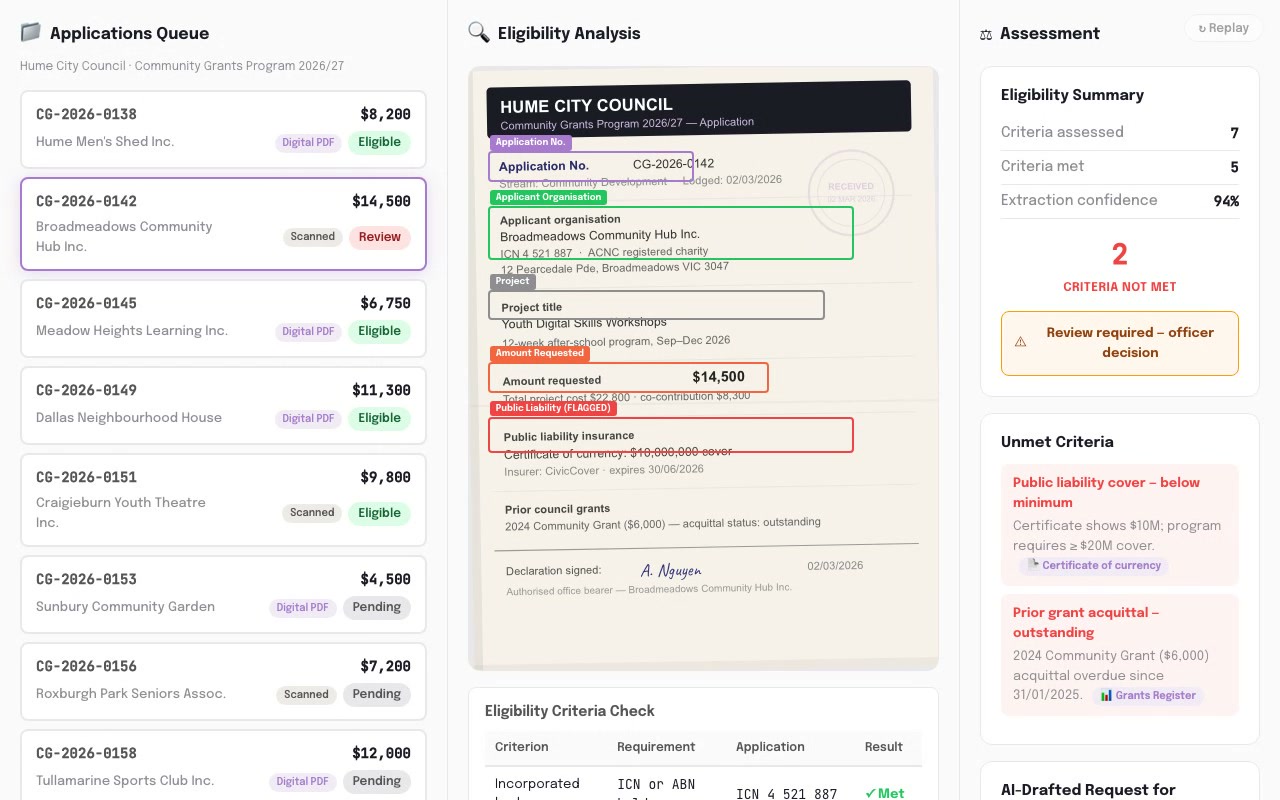
Removes ~40% of out-of-scope applications before they hit the assessor queue.
FOI Triage Logger

Reads each inbound Freedom of Information request, extracts the reference, applicant, date and scope, routes it to the owning department and starts the 30-day statutory clock, then flags requests touching third-party personal affairs for exemption review before the officer signs anything.
Council Enquiry Assistant

A 24/7 first responder for routine rates, waste, and permit enquiries that answers from the council's own published information with citations, and hands the complex or vulnerable cases to staff with the full context attached.
Consultation Submission Drafter

Turns a council or agency consultation notice plus your own prior submissions, policy positions and meeting resolutions into a structured, fully cited first draft — mapping each consultation question to a recorded position and flagging anything unrecorded for an officer to decide.
Tender Compliance Matrix Builder

Turns a document-heavy tender pack into a clause-by-clause compliance matrix — requirement, source clause and page, owner, evidence required, and the risk if it is missed — so the bid/no-bid call is made with the whole picture, not a partial read under deadline.
Supporter Inquiry Triage

Reads each enquiry in a shared inbox, classifies intent and urgency, routes it to the right team, and drafts a values-aligned reply for staff to approve — so urgent requests surface first instead of waiting days behind routine ones.
Restricted-Fund Reconciler
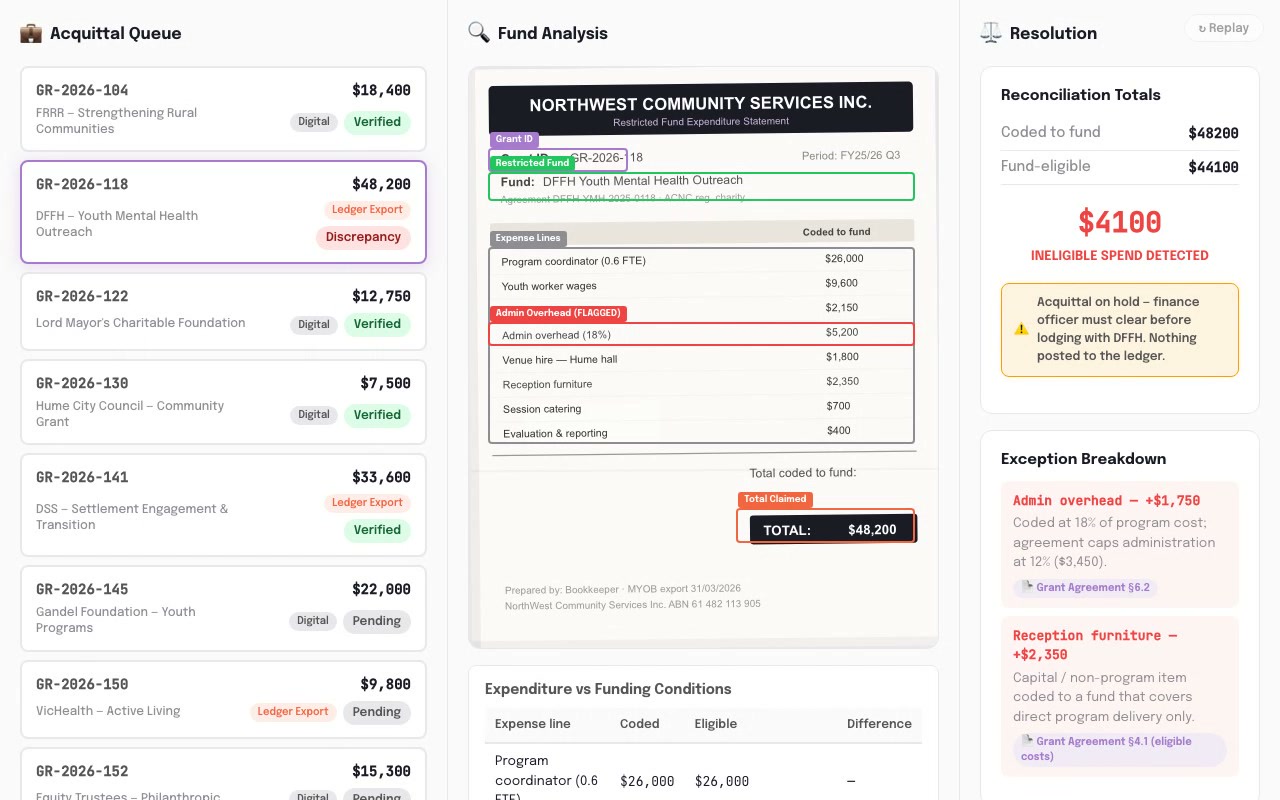
Matches program spending lines against each restricted grant's approved categories and budget, flags every line that doesn't map or that overspends, and hands finance an exceptions list to decide on — turning a manual cross-match into a short review.
Grant Application Reader

Pre-scores 200+ applications against the rubric so the panel meets on the top 30 only.
Engagement Intake & Routing Desk

Reads each inbound enquiry, extracts the client and matter details, classifies the request, runs a conflict check, drafts a holding reply, and routes it to the right team — for a person to review before anything is sent.
Software that connects to AI
Find the integration path for Civic & Government software.
Compare provider APIs, read/write access, MCP support, and practical integration difficulty.
Prompts you can use today, for free.
Sector-specific prompts RMAI uses as starting points. Copy one and run it against de-identified samples — or inside an approved private environment — to see the shape of the answer before you talk to us.
How RMAI would work with you.
Every engagement starts with the diagnostic and scales from there. These link through to how RMAI works.
What a defensible result looks like.
These are published third-party results in comparable Australian and New Zealand public-sector organisations — illustrative of the target RMAI builds toward, with a person reviewing every output. They are not RMAI client claims.
Considering AI for your agency, council, or peak body?
The two-week diagnostic is the right place to start. Fixed scope, fixed price. We’ll tell you whether the pattern fits and what the build would look like.