AI for NDIS & disability providers, grounded in your own participant records and plans.
AI for NDIS & disability providers is grounded, auditable software that RMAI builds on your own participant records, policies, and plan data — so progress notes, claim checks, and reportable-incident triage are drafted, sorted, and cited in minutes, with a human signing off every participant-affecting decision.
Where your participant data lives.
Your participant and plan data stay inside your own tenancy and onshore in Australia, and are never used to train any third-party or public model. A named person — the relevant coordinator, clinician, or compliance owner — reviews and signs every participant-affecting output; the tool drafts and hands off, and does not write back into your system of record unless that integration is wired up in the build.
What actually slows an NDIS provider down.
In plain terms: we map where your participant data flows, then layer AI automation onto the admin that eats your team’s time — so they spend more of the day on participants, not paperwork. The binding constraints in NDIS & disability services are not care quality — they are operational: a documents, data, and handoff load that consumes senior and billable time. Progress notes, claim rework, intake parsing, and incident triage all sit in the spaces between systems, which is exactly where grounded AI pays back.
Providers are growing on brittle margins
Two-thirds of disability providers reported an operating loss in FY24, on an average margin of -3.5%, with staff costs at 81.5% of revenue. Statistical analysis found no clear link between scale and profitability — operational efficiency is the clearest differentiator between surviving and not.
Admin and reporting eat billable, skilled time
Mid-sized providers lose roughly 18–22 hours a week to compliance admin and documentation. Support coordinators routinely report that accounting for their work takes longer than delivering it — unbillable hours that threaten the viability of the role at a frozen Level 2 rate.
Claiming and payment rework is expensive
The scheme's payment error rate was 5.0% in 2023–24, an estimated $2.0 billion impact scheme-wide. Under PACE, pre-payment checks rejected 4.41% of claims. Incomplete records, mismatched rules, and manual transposition turn every rejected claim into hours of detective work and cash-flow drag.
Reportable incidents are missed at the deadline
Only 66.4% of reportable-incident notifications were made within the mandatory 24 hours in Q4 2024–25. Risk signals sit in plain-language notes that no one has time to read in full, so a safeguarding obligation becomes a deadline a tired coordinator can quietly miss.
What changes once the work is grounded in your own records.
Providers working with RMAI recover billable and care hours and tighten their audit trail at the same time. We work in stages — map, then fix, then layer — as a staged cut-over, so your team keeps operating throughout and nothing switches over before it is proven. The outcomes below are illustrative of shipped patterns; every one keeps a person on the final call — nothing finalises a claim or a participant decision on its own.
The questions leaders ask first.
The questions below are the ones RMAI hears in the first call — on safety, staffing, compliance, cost, and feasibility.
What the time recovered is worth.
Move the sliders for your own volumes; the benchmark shows where shipped builds have landed.
| Task | Before | After |
|---|---|---|
| Progress note (write + file) | ~15 min, after hours | < 2 min (review) |
| Support-coordination progress report | hours of synthesis | draft in minutes |
| Claim processing (straight-through) | ~25% no-touch | ~70% no-touch |
| Reportable-incident signal | found at audit | flagged in < 24 hr |
What RMAI has built for this sector.
The applications below are grounded, human-in-the-loop tools for this sector — some already built and shipped, some scoped from real briefs. Ask us which is which.
Support-Coordination Report Drafter

Turns weeks of scattered case notes and provider service logs into a draft progress report mapped to the participant's plan goals, with the source note cited behind every claim — the coordinator reviews and signs.
NDIS Service Agreement Generator
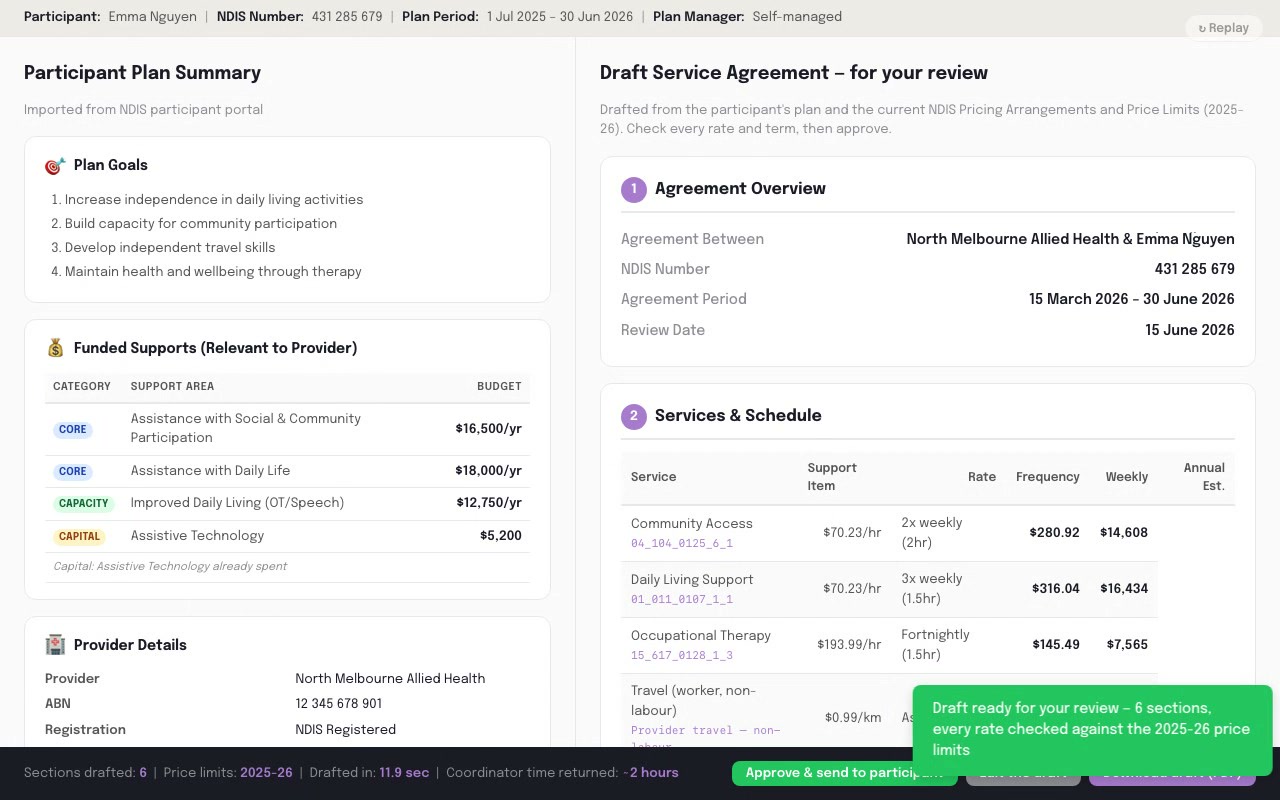
Draft a participant service agreement from the plan and the current price limits in minutes — every rate, support item and cancellation term in place before a coordinator signs off.
Reportable-Incident Signal Triage

Reads the daily progress-note flow, quotes the plain-language wording that looks like a possible reportable incident, rates its confidence, and routes it to your Approver against the 24-hour clock — flagging, never lodging.
NDIS Plan Dashboard

Catches NDIS funding that would otherwise expire unspent — and leaves every spending decision with a person.
NDIS Progress Note to Claim

Turn a support worker's session note into a draft NDIS claim — the right support item, the matching plan goals, and the compliance checks already done, for a person to approve.
SIRS Incident Triage Assistant

Reads each incident note against the eight reportable-incident categories, surfaces the likely category, priority and notification deadline, and drafts the notice for a clinician to approve — so a night-shift under-call doesn't quietly blow the 24-hour window.
Shift Handover Summariser

Turns a shift's scattered progress and incident notes into a one-page ISBAR-structured handover — vitals, meds, intake, mobility, falls, mood — with the source note quoted on every line and clinical risks flagged for the RN.
Provider Intake Sorter

Reads every inbound referral — GP chronic condition management plan, NDIS plan, My Aged Care RFS, scanned form, email — and lands each one in the right queue with the funding fields already filled.
Plan Reassessment Drafter

Turns a participant's file into a first-draft plan reassessment report your coordinator edits down, instead of starting from a blank page.
Complaint Response Agent

Triages every patient complaint the moment it lands, flags the clinical-safety ones, and drafts a policy-grounded acknowledgement for staff to approve.
Clinic Policy Concierge

Staff ask about an SOP, a payer rule, a consent requirement or a care protocol and get a short answer that quotes the exact section it came from — and says "not in your documents" instead of guessing.
Case-Note Impact Synthesiser

Reads a de-identified case note against your own outcomes framework and drafts the structured entry — Star scores, goal progress, risk flags — with every value traced to its source, so a program manager reviews in an hour instead of retyping notes into report fields for days.
Care Policy Concierge

Answer staff "what does our policy say?" questions from your approved document library — with the clause cited, and a refusal when the answer isn't there.
Care Policy AskMe

Answers a carer's policy or procedure question at the point of care from your own approved library — quoting the section, naming the document and version, and saying so when the answer isn't there.
Software that connects to AI
Find the integration path for NDIS & Disability software.
Compare provider APIs, read/write access, MCP support, and practical integration difficulty.
Prompts you can use today, for free.
Sector-specific prompts RMAI uses as starting points. Copy one and run it against de-identified samples — or inside an approved private environment — to see the shape of the answer before you talk to us.
How RMAI would work with you.
Every engagement starts with the diagnostic and scales from there. These link through to how RMAI works.
What a defensible result looks like.
These are published third-party results in Australian care and NDIS operators — illustrative of the target RMAI builds toward, with a human in the loop throughout. They are not RMAI client claims.
Considering AI for your NDIS operation?
The two-week diagnostic is the right place to start. Fixed scope, fixed price. We’ll tell you whether the pattern fits and what the build would look like.