AI for Accounting Firms | Real Minds AI
Industry · Accounting & Bookkeeping

AI for accounting firms, grounded in your own client files, engagement letters, and prior work papers.

Get compliance season back without hiring the accountants you can’t find — your agent still signs, and client data never leaves your tenancy.
In one line

AI for Australian accounting & bookkeeping firms and registered tax agents is grounded, auditable software that RMAI builds on your own client files, engagement letters, and prior work papers — so return prep, BAS and bookkeeping, STP Phase 2 checks, award and payroll reconciliation, SMSF work papers, scope-versus-billing review, and the conflict-checked intake flood are drafted, cited, and source-linked in minutes, with a registered agent or principal reviewing and signing off every result.

Last updated 7 June 2026·TA reviewed by Tracy Anthony, principal · RMAI
Before anything else

Two things accountants ask first: will it invent things, and is client data safe?

Accountants have already seen general-purpose AI used badly — confident answers, invented references, no defensible trail — and several have been burnt. That is not good enough for tax, BAS, payroll, advisory, or client records. RMAI does not build ask-anything chatbots that guess at tax positions. We build constrained tools that work from your own documents, cite their sources, flag uncertainty, and route every consequential output to a registered agent, principal, payroll officer, or engagement owner. The goal is not to automate professional judgment — it is to remove the low-value document handling that happens before judgment can begin.

No unsupported answers
Every figure links to its source document, clause, or prior work paper. If it isn’t in the material you supplied, the tool says so — it never fills the gap from training data.
No silent decisions
The tool drafts, extracts, checks and flags. A registered agent, payroll officer or engagement owner approves, edits, rejects or signs. Nothing is lodged, sent, or posted on its own.
No false confidence
Where the evidence is missing or ambiguous it returns ‘not on file’ or ‘needs review’ rather than guessing — the failure mode that burns firms is the one we design against.
Client data stays yours
Built inside your own tenancy and working alongside the systems you already run, such as Xero, XPM, FYI and Karbon, via their APIs. Your client ledgers and financial data stay inside your own tenancy and onshore in Australia, and are never used to train any third-party or public model; TFNs are never routed through a public chatbot.

What a build must prove before it goes live

Where is the data stored?
Inside an approved tenancy, database, or document environment that the firm controls.
Who can access it?
Role-based, least-privilege access under the Australian Privacy Principles, with firm-controlled permissions.
What leaves the system?
Controlled model calls, with logging, redaction, and retention the firm can audit.
Can we defend the output?
Source links, version history, review status, and a registered-agent sign-off on every consequential result.

What we won't automate

  • Deciding a final tax position without registered-agent review.
  • Lodging returns, BAS, STP, or payroll corrections automatically.
  • Giving client-specific advice without a professional reviewing the facts.
  • Pushing TFNs or payroll files through public AI tools.
  • Relying on an answer whose source evidence cannot be checked.
01The situation

What actually squeezes an Australian accounting firm now.

The constraint isn’t winning work — it’s clearing it. Accountants are on the national shortage list and only about half of accounting vacancies get filled, so compliance lands back on the partners while clients ask for advisory the team has no hours left to give; nearly two in three individual returns ride on registered agents inside one lodgement program; and STP Phase 2 pay-category mapping, the 12% super guarantee, and the new criminal wage-theft law turn a small reconciliation slip into a real exposure. None of these is a tax-thinking problem — each is a documents-and-reconciliation problem, the hour lost before the thinking starts, which is exactly where grounded AI — constrained to your documents, cited, and reviewed — earns its place. And the caution accountants feel about AI is well-founded: a general chatbot will confidently hallucinate, and confidentiality is non-negotiable — both are addressed head-on below, before anything else.

55%tax-accountant fill rate

You can't bill the work because you can't hire the people

Accountants and auditors are on the Jobs and Skills Australia shortage list. In CA ANZ's 2025 vacancy survey only 55% of taxation-accountant roles and 49% of general-accountant roles were filled — well under the 67% mark that signals a genuine shortage. The binding constraint isn't demand; it's capacity. Every seat you can't fill is compliance work that lands back on the partner's desk, and advisory revenue you never get to.

· CA ANZ vacancy survey 2025 (159 members; fill rates by role); Jobs and Skills Australia Occupation Shortage List 2025
12%super, criminal underpayment

A reconciliation slip is now a wage-theft exposure

The super guarantee rose to 12% of ordinary time earnings on 1 July 2025, and from 1 January 2025 intentional underpayment is a criminal offence under the Fair Work Act — up to 10 years' prison and $1.65M for an individual. The law turns on intent, not honest mistakes, and there's a small-business safe harbour, but the burden has shifted: the same team meant to pivot to advisory is the team whose payroll reconciliation now carries criminal weight if it's wrong.

· ATO super guarantee (12% from 1 Jul 2025); Fair Work Ombudsman — criminal underpayment laws from 1 Jan 2025
62.8%of returns via agents

Two in three individual returns ride on your desk — at the same deadline

Tax agents lodged 62.8% of individual returns in 2022–23 (myTax 36.7%), and the ATO had received over 12.8 million individual lodgments for 2025 by late January 2026. That volume hits inside one compressed lodgement program, and the slow part isn't the tax thinking — it's the hour per client spent keying a shoebox into categories before any thinking can start.

· ATO Taxation Statistics 2022–23 (lodgment method); ATO Tax Time lodgment statistics (Jan 2026)
4BAS quarters, one team

STP Phase 2 mappings and four BAS quarters land on the same desk

STP Phase 2 has been mandatory since 2022, and it pushed the detail down to the pay-category line — every allowance, every leave type, every salary-sacrifice code now has to map to a specific ATO income type, or it's a correction event at lodgement. On top of that sit four quarterly BAS cycles (28 Oct, 28 Feb, 28 Apr, 28 Jul — agents get a lodgment-program extension on three of the four). The slow part isn't the GST thinking; it's the line-by-line mapping and reconciliation that has to be right before the thinking starts.

· ATO STP Phase 2 employer guidance; ATO BAS due dates (quarterly; registered-agent lodgment program)
02The value

What changes once the work runs on your own client files and engagement terms.

Firms working with RMAI get accountant hours back and tighten their compliance trail at the same time. The outcomes below are illustrative of patterns RMAI has shipped; each keeps a person on the final call — no return is lodged, no back-pay posted, and no invoice sent on its own. The registered agent, payroll officer, or engagement owner reviews and signs.

30–50%
Less time keying and reconciling per return
AI reads each receipt, bank statement and STP income statement, proposes an ATO category and return line for every dollar, flags duplicates and capital items, and links each figure to its source page. The registered agent reviews, resolves the flags, reconciles against the ATO prefill, and signs — the lodgement stays human.
beforelodgement
STP Phase 2 and award errors caught before they leave
A pay-category auditor classifies each code against the ATO STP Phase 2 income types and flags vague mappings; an award-rate checker reconciles each payslip line against the modern award with the clause cited. A payroll officer approves before any correction or back-pay is posted — the catch happens before the run, not at audit.
$0scope leakage
Out-of-scope work and rate variances flagged pre-bill
Each draft invoice is cross-checked against the engagement letter scope and rate card before it goes out — out-of-scope hours, rate mismatches and non-billable time surfaced with the clause attached. The engagement owner approves, edits or rejects; the tool never sends, holds, or writes off on its own.
03FAQs

The questions leaders ask first.

The questions below are the ones RMAI hears in the first call — on safety, staffing, compliance, cost, and feasibility.

Because that is the exact failure mode RMAI designs against — and you are right to have been burnt by it. A consumer chatbot answers from its training and will confidently hallucinate: invent a deduction, a rate, or a clause, because it is built to sound fluent, not to be grounded. RMAI tools work the opposite way — they only read your own client documents, the ATO STP Phase 2 income types, and the modern award text, and they show the source page behind every figure. Extraction is kept separate from interpretation; when a document is ambiguous or the answer isn’t in the source, the tool returns ‘not on file’ or flags it for review rather than guessing; nothing is auto-lodged; and a registered agent signs off. So the question stops being ‘will it make something up?’ and becomes ‘how much of the document handling can it take off my desk before the thinking starts?’ A grounded answer can still be wrong — a stale source, or a quiet miss you wouldn’t spot; that is why nothing here is rubber-stamped: a person reviews the output before it is relied on.
Yes — when it is scoped correctly, which is the first conversation, not an afterthought. RMAI builds inside your own tenancy (Microsoft 365, your practice and ledger systems such as Xero) through their APIs; client financials and TFNs are not routed through a public chatbot and not used to train third-party models. The assistant only sees the documents you point it at, access is role-based under the Australian Privacy Principles, and every figure is cited to its source. Uploading a client’s tax pack to a consumer AI is the real risk — that is exactly what this avoids.
Only as a first pass that a registered agent reviews — which is how RMAI builds it. The tool proposes a category and a return line for each document and shows the source page behind every figure, so the agent checks the claim against the client’s actual circumstances. The substantiation calls — whether the $300 written-evidence rule is met, whether an expense is genuinely work-related, whether apportionment is right — stay with the agent, where the reasonable-care obligation sits. Nothing is auto-lodged; a refund estimate is an orientation figure, not advice.
Directly, and that is the point. With accountants on the national shortage list and only about half of accounting vacancies being filled, the lever that moves is capacity per head, not headcount. RMAI tools take the keying and reconciling off the desk — return prep from source documents, STP Phase 2 and award checks, scope-versus-billing review, conflict-checked intake — so your existing team clears the lodgement program and has hours left for advisory. It recaptures capacity; it does not replace the accountant, and a registered agent signs off every consequential output.
No. RMAI tools draft, check and flag; your people decide. What gets automated is the drudgery — reading documents, proposing categories, matching figures, catching duplicates, line-by-line award and scope checks — not the judgement, the client advice, or the lodgement. On a workforce you can’t fully staff, the gain shows up as reclaimed capacity and faster turnaround, not fewer people. We accelerate the thinking; we do not replace the thinker.
You are, exactly as you are now. Under the Code of Professional Conduct in the Tax Agent Services Act, taking reasonable care in ascertaining a client’s affairs (Code item 9) and applying the taxation laws correctly (item 10) is a registered agent’s duty that cannot be delegated to software. RMAI tools produce a source-linked draft; the registered agent reviews, corrects and signs. Lodging a return for a fee is restricted to TPB-registered agents — the tool never lodges and never decides a tax position. It gets you to the right answer faster; it does not become the answer.
RMAI always starts with a fixed-price AI working session ($4,500, credited against the build) that tells you whether the pattern fits before any build. A focused build typically ships in 3–6 weeks in the $10k–$60k AUD band — not a six-figure platform. The smallest useful build — one tool, such as a single bank/ledger reconciler on its own — starts from about $10,000, so a small practice does not have to assume the top of the band. Most of the work is already done: these tools are skins of patterns RMAI has shipped before, so a smaller practice pays for the bespoke ~30%. Honest qualifier: if your prep time is dominated by chasing missing documents and resolving private-versus-business questions rather than by keying what you already have, this saves you less than you’d hope.
04ROI

What the time recovered is worth.

Move the sliders for your own volumes; the benchmark shows where shipped builds have landed.

Illustrative — run it on your own client volumes
Documents handled / month300
Minutes saved / document45
Loaded staff cost / hour$90
$243,000 AUD / year
2,700 senior-staff hours returned each year. Directional — we firm this up in the diagnostic.
On these illustrative numbers a $10k–$60k build pays back in roughly 1–4 months; your real figure depends on your own client volumes and document quality. · Net of the human review step — a registered agent checks and signs every output, so this is time recaptured for review and advisory, not staff removed off the P&L.
Benchmark · per-task, shipped builds
before → after
TaskBeforeAfter
Return prep from source documents~1 hr/client keying30–50% reclaimed (agent reviews)
STP Phase 2 category checkhand-checked at lodgementaudited before lodgement
Award / payslip reconciliationspot-checked, caught at auditevery line, before the run
Scope vs billing reviewskimmed, leakedflagged pre-bill, owner signs
05Applications

What RMAI has built for this sector.

The applications below are grounded, human-in-the-loop tools for this sector — some already built and shipped, some scoped from real briefs. Ask us which is which.

SMSF Workpaper & Compliance Pre-Check
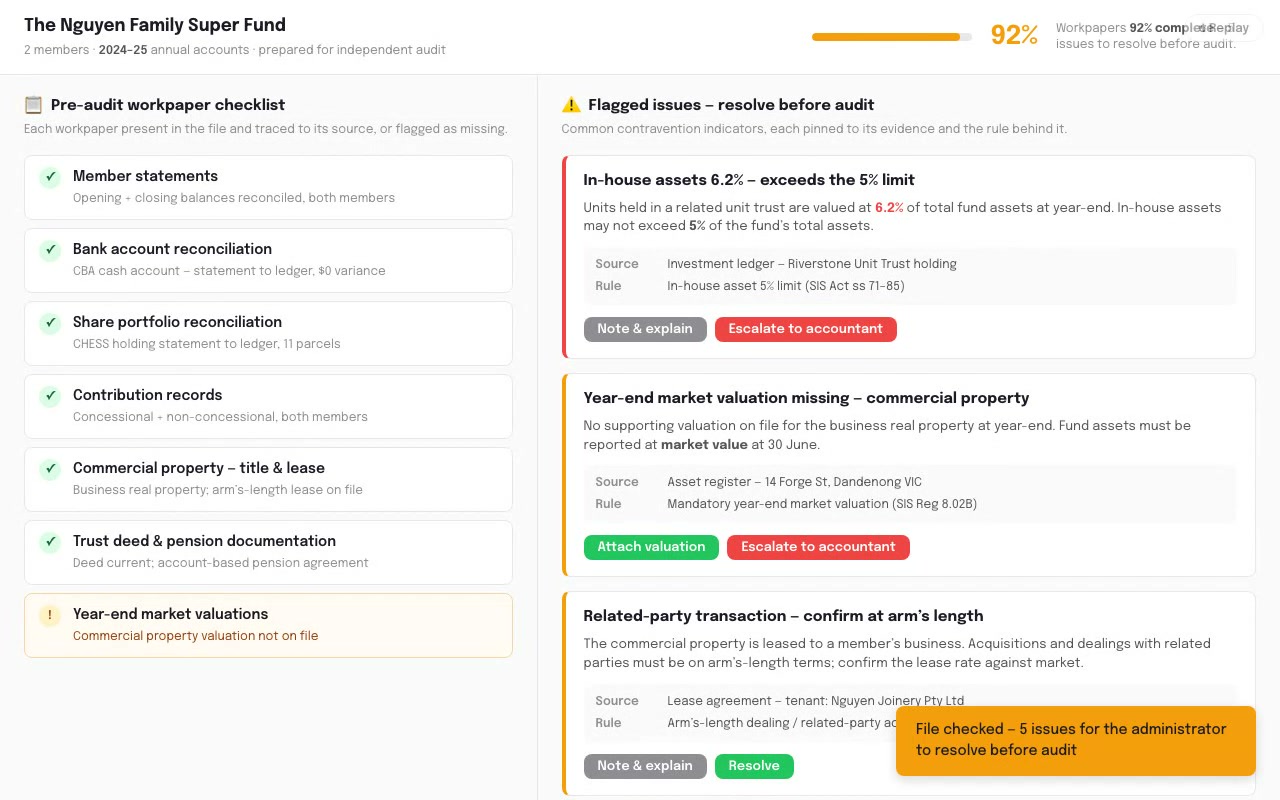
SMSF Workpaper & Compliance Pre-Check - Accounting AI application
AccountingDocument processinginteractive demo

Checks each SMSF file for complete workpapers and the common contravention indicators — caps, in-house assets, related-party dealings, year-end market valuations — so the administrator fixes gaps before the file reaches the independent auditor.

build est. · 4–6 weeks

Management Report Drafting Assistant

Management Report Drafting Assistant - Accounting AI application
AccountingDraftinginteractive demo

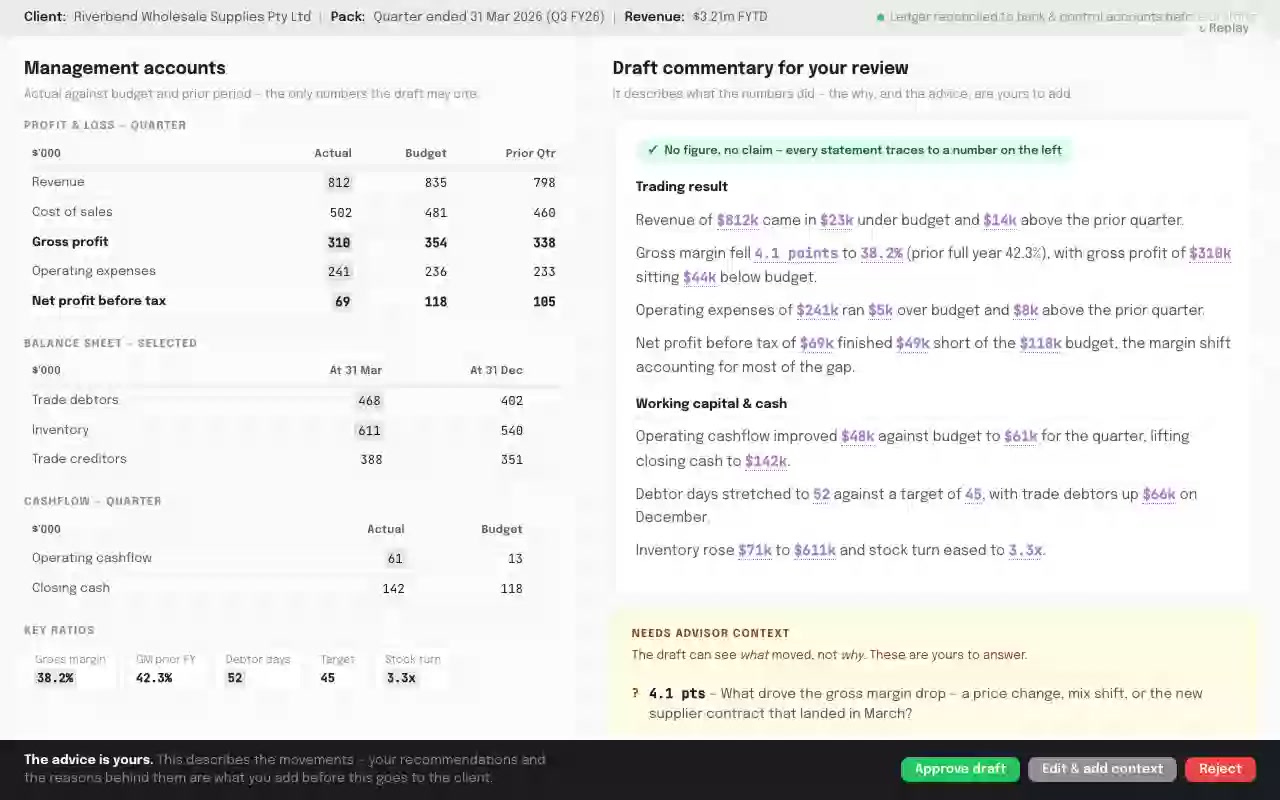
Drafts plain-English commentary from the client's management accounts — variances, trends, ratios, cashflow movements — with every statement tied to the figure behind it, so the advisor edits insight rather than building the report.

build est. · 3–6 weeks

FBT Return Prep Assistant

FBT Return Prep Assistant - Accounting AI application
AccountingDocument processinginteractive demo

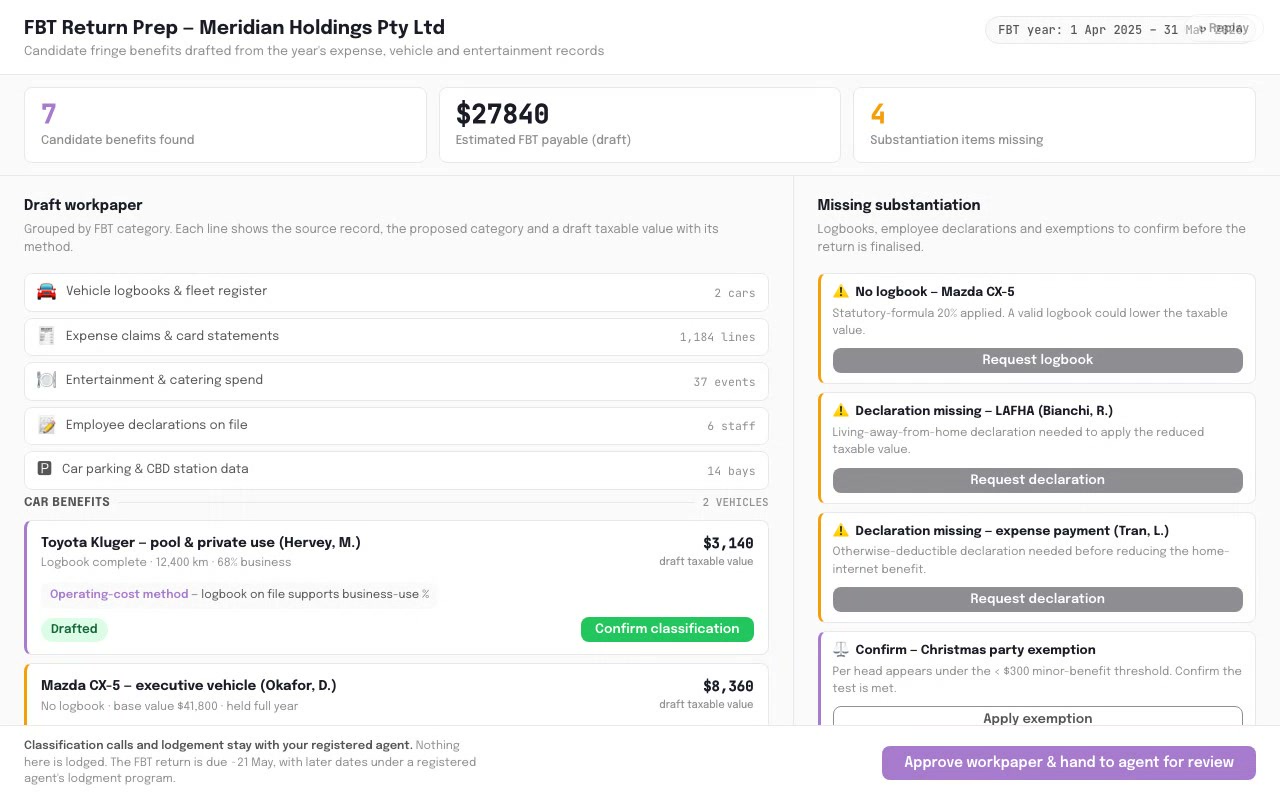
Scans the year's expense, vehicle and entertainment records to surface and classify potential fringe benefits, draft taxable values, and flag missing declarations and logbooks — so the agent reviews a structured draft instead of hunting benefits across the ledger.

build est. · 4–6 weeks

BAS Evidence & GST Review

BAS Evidence & GST Review - Accounting AI application
AccountingDocument processinginteractive demo

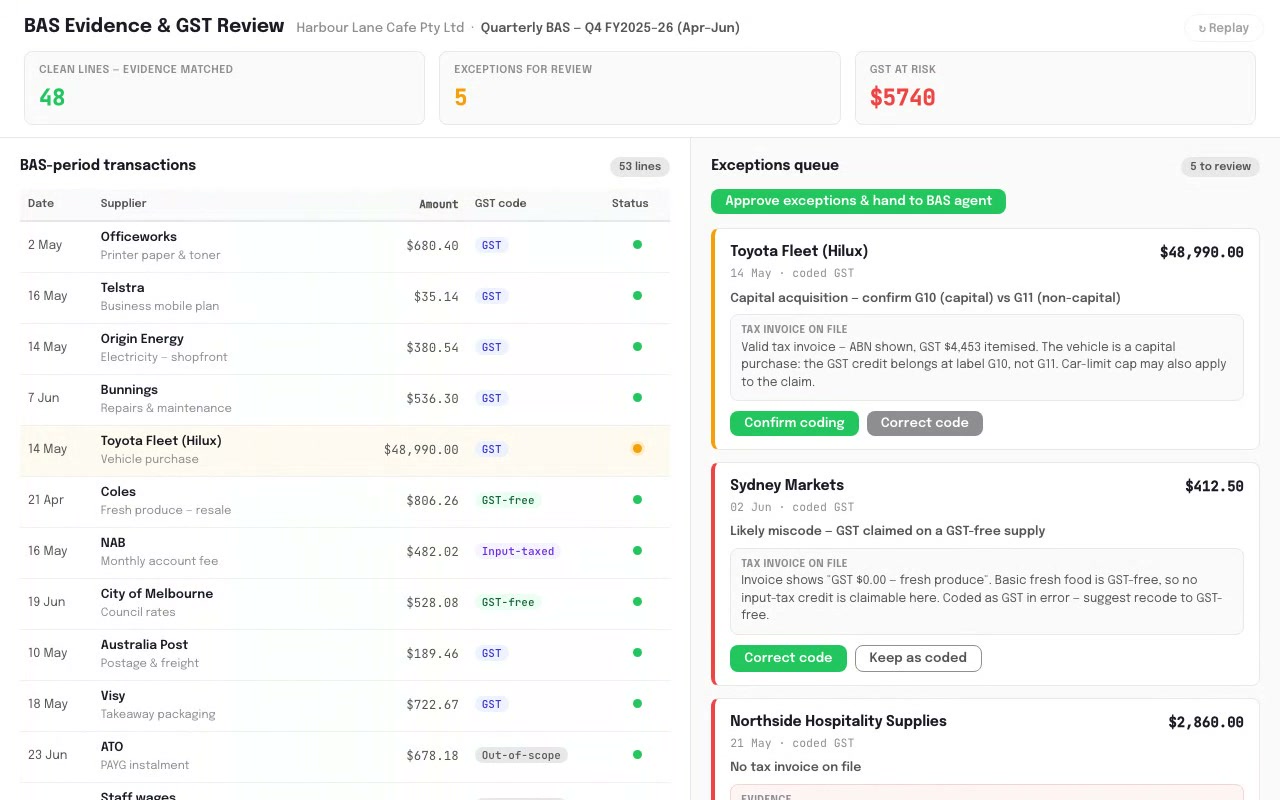
Cross-checks each transaction's GST code against the supporting tax invoice and your coding rules, so the BAS agent reviews flagged exceptions instead of eyeballing the whole ledger before lodgement.

build est. · 3–6 weeks

Bank-Feed Coding Assistant

Bank-Feed Coding Assistant - Accounting AI application
AccountingDecisioninginteractive demo

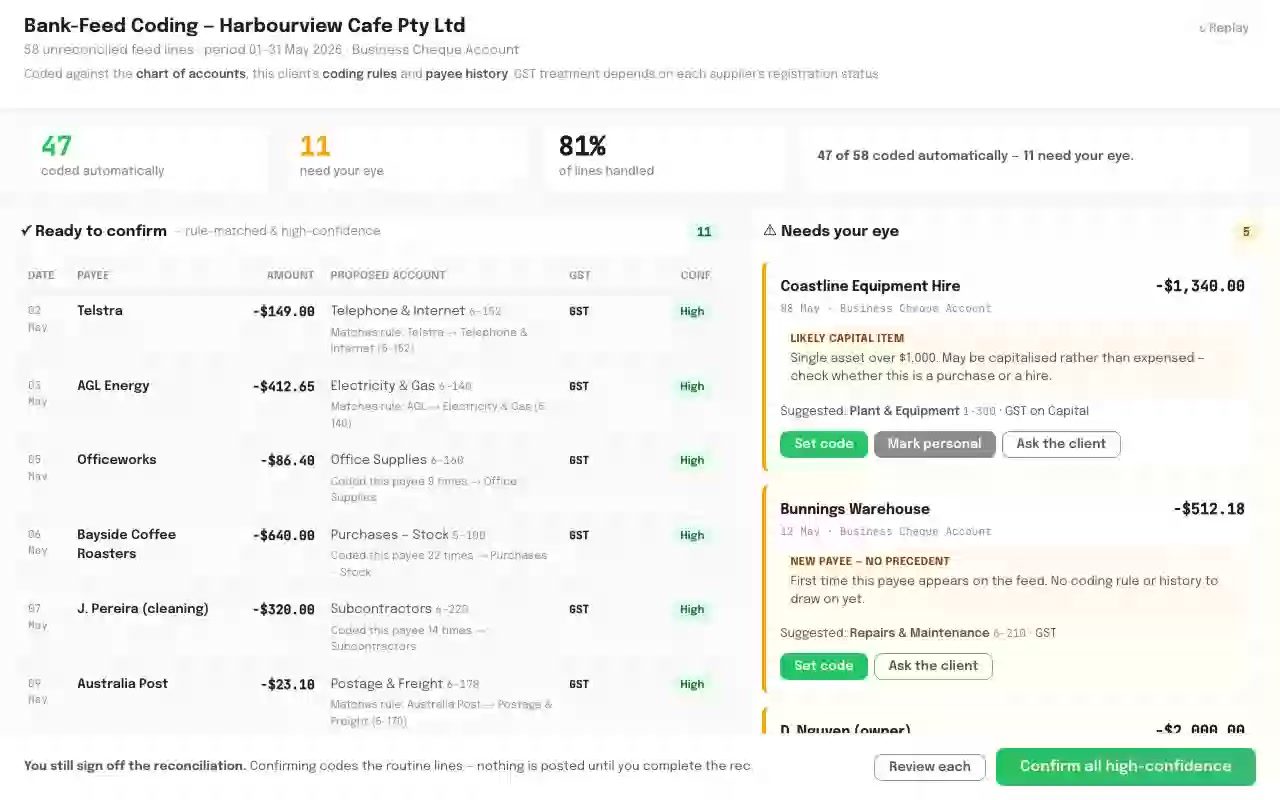
Drafts the account and GST code for each bank-feed line from your chart of accounts, coding rules and payee history — so the bookkeeper confirms and handles the genuine exceptions, not the 80% that repeat.

build est. · 3–5 weeks

Also useful here

Tax Return Prep from Source Documents

Tax Return Prep from Source Documents - Professional Services AI application
AccountingProfessional ServicesDocument Generationinteractive demo

Turn a shoebox of client receipts, bank statements and income statements into a categorised, source-linked deduction schedule the agent can review in minutes — not an evening of data entry.

build est. · 4–6 weeks

STP Phase 2 Category Auditor

STP Phase 2 Category Auditor - HR & Payroll AI application
AccountingHR & PayrollDocument processinginteractive demo

Audits pay-category mappings against ATO STP Phase 2 income types and flags generic or high-risk codes before lodgement — heading off correction events and audits.

build est. · 2–3 weeks

Scope & Billing Guardian

Scope & Billing Guardian - Professional Services AI application

Reviews each draft invoice against the engagement letter scope and agreed rate card before it goes out — flagging out-of-scope work, rate variances and non-billable time, and drafting the adjustment note for the engagement owner to clear.

build est. · 3–5 weeks

Precedent & Knowledge Finder

Precedent & Knowledge Finder - Professional Services AI application

A fee-earner asks a question in plain language and gets the answer from your own precedents, advice, policies and matter files — with the exact document, version and clause quoted, and an honest "not on file" when it isn't there.

build est. · 3–4 weeks

Inbox Triage

Inbox Triage - Professional Services AI application

Turns a chaotic shared inbox into a sorted, urgency-ranked queue with drafted replies — so the morning starts with the work, not the sorting.

build est. · 2 weeks

Engagement Intake & Routing Desk

Engagement Intake & Routing Desk - Professional Services AI application
AccountingCivic & GovernmentLegalProfessional ServicesCustomer-service agentinteractive demo

Reads each inbound enquiry, extracts the client and matter details, classifies the request, runs a conflict check, drafts a holding reply, and routes it to the right team — for a person to review before anything is sent.

build est. · 3–4 weeks

Award Rate Checker

Award Rate Checker - HR & Payroll AI application

Reconciles every payslip line against the modern award before the pay run leaves, so an underpaid weekend penalty or missed allowance gets caught — and corrected — before it becomes a wage-theft exposure.

build est. · 3–4 weeks

06Prompts

Prompts you can use today, for free.

Sector-specific prompts RMAI uses as starting points. Copy one and run it against de-identified samples — or inside an approved private environment — to see the shape of the answer before you talk to us.

Run these against de-identified samples, synthetic data, or inside an approved private environment — never paste client records, TFNs, bank statements, or work papers into a public AI tool. In a real firm the safe version runs inside your tenancy with access controls, logging, retention settings, and a review step.

Return prep
From the client source documents below (receipts, bank statements, STP income statement, rental and insurance statements), extract each line and propose an ATO category and return label. Flag duplicates, and flag any capital item as needing a depreciation-vs-write-off decision rather than asserting the threshold. Link every figure to its source page with a confidence flag. Do NOT assign a final position and do NOT lodge — output for a registered agent to review and sign.
STP Phase 2 audit
Audit the pay categories in the payroll register below against the official ATO STP Phase 2 income types. For each category, state the mapped income type and quote the basis. Flag any generic or vague code (e.g. 'other allowance') as high risk for a human to correct before lodgement. Do NOT lodge or finalise — output for a payroll officer to review.
Award check
For each payslip line below, compare the paid rate to the modern award minimum for that classification and shift, versioned to the pay period. Compute the shortfall and cite the clause. Route anything you can't reconcile from the payslip (e.g. an unsplit 'weekend' shift, a folded-in casual loading) to review rather than guessing. Do NOT post back-pay — draft a correction memo for a payroll officer to approve, edit, or reject.
Pre-bill review
Check each line on the draft invoice below against the engagement letter scope, the agreed rate card, and the non-billable rules supplied. Flag out-of-scope work, rate variances, and non-billable time, each pinned to the governing clause, and draft an adjustment note. Do NOT send or adjust the invoice — present the held draft for the engagement owner to approve, edit, or reject.
08Proof

What a defensible result looks like.

These are published government and third-party figures — illustrative of the load RMAI builds toward relieving, with a registered agent or payroll officer on the decision throughout. They are not RMAI client outcome claims, and any per-firm time saving re-baselines down to your own client volumes and document quality.

62.8%
of individual tax returns lodged through registered agents in 2022–23 — the compliance volume that lands on accounting firms inside one lodgement program (a registered agent reviews and signs every return)
ATO Taxation Statistics (AU)Tax agents lodged 62.8% of individual returns in 2022–23 (myTax 36.7%); the ATO had received over 12.8M individual lodgments for 2025 by late January 2026 — the compressed compliance volume firms carry · ATO Taxation Statistics 2022–23 (lodgment method); ATO Tax Time lodgment statistics, Jan 2026
CA ANZ / Jobs and Skills Australia (AU)Only 55% of taxation-accountant and 49% of general-accountant vacancies were filled in CA ANZ's 2025 survey — under the 67% mark that signals a shortage — with accountants and auditors on the national Occupation Shortage List. This is the capacity gap AI capacity-recapture targets · CA ANZ vacancy survey 2025 (159 members; fill rates by role); Jobs and Skills Australia Occupation Shortage List 2025
Tax Practitioners Board (AU)The Code of Professional Conduct (TASA) holds the registered agent to reasonable care in ascertaining a client's affairs (item 9) and applying the law correctly (item 10) — the duty that keeps a person, never the tool, on every lodged position · TPB — Code of Professional Conduct, reasonable care (Code items 9 & 10), Tax Agent Services Act 2009

Facing compliance season with the staff you couldn't hire?

The two-week diagnostic is the right place to start. Fixed scope, fixed price. We’ll tell you whether the pattern fits and what the build would look like.

How We Work Proof Talk to us
Ask us anything